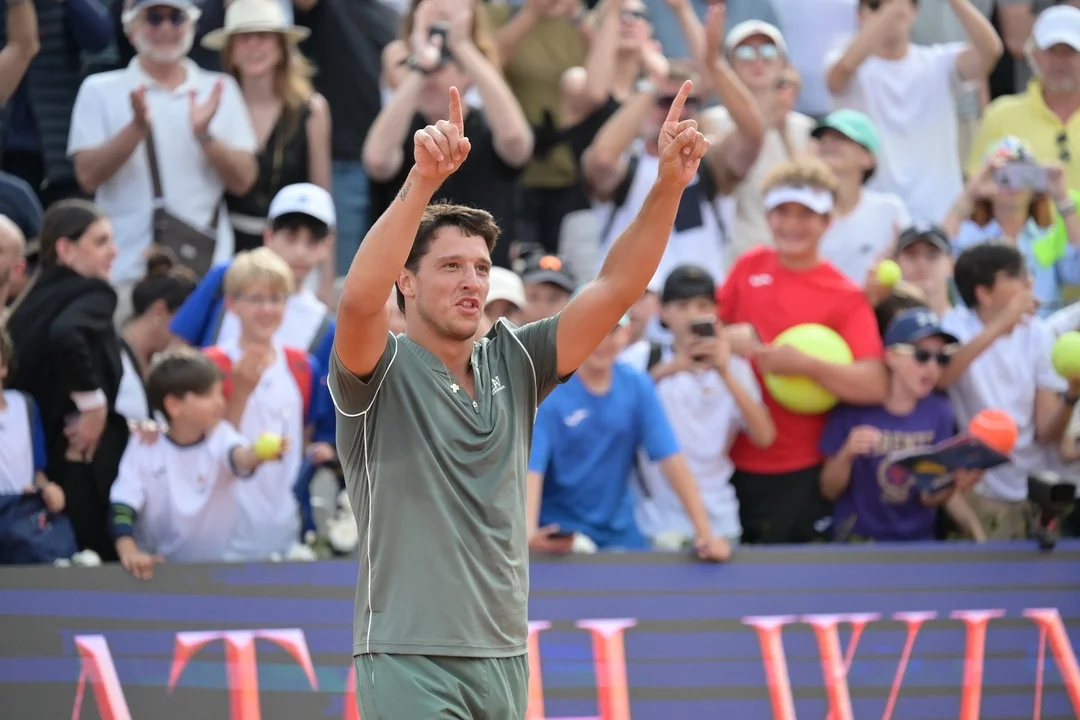
Luciano Darderi produced one of the most extraordinary comebacks in recent Masters 1000 history, saving four match points in a second-set tiebreak before demolishing Alexander Zverev 6-0 in the decider to reach his first quarterfinal at this level. The Italian-Argentine trailed 1-6, 4-5 and was two points from defeat multiple times, but Zverev's composure cracked at the worst possible moment and the Roman crowd did the rest - Darderi finished with 87 total points won to Zverev's 85 in a match decided by the finest of margins. Jannik Sinner continued his serene march through the draw with a 26th consecutive victory over home qualifier Andrea Pellegrino, equalling the longest winning streak of his career. Rafael Jodar matched his Madrid quarterfinal by dismantling Learner Tien, while Casper Ruud reached his fifth Rome quarterfinal at the expense of an injured Lorenzo Musetti. Karen Khachanov ended Dino Prizmic's dream week in composed fashion, and Andrey Rublev needed an emotional reset - triggered by a penalty point - to come from a set down against Nikoloz Basilashvili. Martin Landaluce's lucky loser run reached the quarterfinals with a mature victory over Hamad Medjedovic.
Darderi stuns Zverev in epic Rome comeback
The story of the day belonged to Luciano Darderi, who produced an unforgettable comeback victory over Alexander Zverev to secure the first top-10 win of his career and his first-ever Masters 1000 quarterfinal. More than just the result itself, it was the way the match unfolded that turned the Roman afternoon into something the Italian-Argentinian is unlikely to ever forget. At the start, it looked like Zverev had stepped onto court with the clear intention of giving his opponent absolutely no hope. The German was untouchable for the entire opening set, blasting winners from the baseline and serving flawlessly on his way to a brutal 6–1 in just 28 minutes. Darderi later spoke about suffering from a slight sunstroke early in the match, but the reality is that there was probably very little anyone could have done against that version of Zverev, even at full strength. The beginning of the second set suggested a more competitive battle, especially after Darderi earned an early break. Yet once again the world No. 3 immediately restored order, breaking back and eventually stepping up to serve for the match. At that point, almost nobody inside the stadium could have imagined what was about to happen. Darderi had already produced a comeback against Tommy Paul in the previous round, but repeating that feat against Zverev felt impossible. Instead, taking advantage of a few small moments of hesitation from the German, including a double fault at the start of a crucial game, the Italian clawed his way back into the set and forced a tiebreak of astonishing drama. There, he saved four match points before eventually taking it 12–10. From that moment on, the atmosphere completely changed. With the Italian crowd in full eruption, Darderi playing in a state of pure competitive trance and Zverev visibly shattered mentally, the third set turned into a one-sided procession. The world No. 20 stormed through it 6–0, mixing brutal baseline exchanges with confident net approaches, producing the kind of performance that instantly becomes part of a player's career narrative. The statistics reflected just how narrow and dramatic the battle truly was. Darderi finished with 87 total points won against Zverev's 85, while converting five breaks and winning 42% of points against the German's second serve. Just as importantly, he stayed mentally alive long enough to survive the decisive moments — and once the match shifted emotionally, there was no way back for Zverev.
Sinner extends winning streak to 26 in Pellegrino derby
The daily Jannik Sinner numbers update continues: a 19th consecutive win in an all-Italian matchup, maintaining a perfect record in domestic clashes, and a 26th straight victory overall, equalling the longest winning streak of his career previously achieved between 2024 and 2025. At the beginning, it seemed as though the emotion of Andrea Pellegrino finding himself, at 29 years old, on Rome's Centre Court against the world No. 1 was completely overwhelming him. Sinner raced to a 4–0 lead almost effortlessly, controlling every exchange with his usual authority. However, midway through the set, Pellegrino finally loosened up after a confident net approach finished with a beautiful demi-volley, a moment that visibly helped him settle into the match. From that point onward, the level became much more competitive. While Sinner always remained firmly in control, Pellegrino showed enough quality and personality to suggest that this week in Rome could represent the beginning of something meaningful rather than just an isolated breakthrough run.
Jodar matches Madrid run with dominant Tien dismissal
Rafael Jodar matched his Madrid result by reaching the quarterfinals once again, continuing to impress and increasingly looking like a genuine future challenger capable of joining the Sinner-Alcaraz rivalry on clay over the next few years. The young Spaniard dismantled Learner Tien in straight sets, producing another opening set very similar to the one he played against Matteo Arnaldi: relentless movement, constant pressure and complete control of the baseline exchanges on the way to a dominant 6–1. What still appears to be missing, at least for now, is the ability to maintain that intensity for an entire match. Just like against Arnaldi, Jodar's level dropped in the second set and he quickly found himself down a break. This time, however, he avoided the physical and emotional cost of a third set by immediately regaining control and completing the comeback before the match could truly reopen. Statistically, the Spaniard dominated almost every category. He won 68% of service points, 50% of return points and converted four of eight break opportunities, while also forcing Tien into 23 unforced errors through his aggressive court positioning and relentless tempo. Tien nevertheless leaves Rome with plenty of positives after achieving the best clay-court result of his career. The 20-year-old American grew up primarily on hard courts, but this week showed signs that he may also be capable of building a strong future on clay.
Ruud reaches fifth Rome quarterfinal as Musetti's thigh gives way
Lorenzo Musetti's injured thigh already suggested that the highly anticipated clash with Casper Ruud could end up being less spectacular than expected, and that ultimately proved true, especially in the second half of the match. The Italian managed to stay level with a more confident and in-form Ruud until 3–4 in the opening set, when the Norwegian earned the decisive break helped by a double fault from Musetti. From that moment on, the match completely shifted. Musetti began to lose tactical clarity, often abandoning structure in rallies while repeatedly complaining about pain in his left leg, and the second set quickly slipped away in a one-sided 6–1 finish. Ruud, meanwhile, reached the Rome quarterfinals for the fifth time with one of his cleanest performances of the season. Beyond the solidity from the baseline that has always defined his clay-court tennis, the Norwegian also showed something relatively unusual in his game: a progressive willingness to take the court earlier and finish points at the net. It is a tactical evolution not often associated with a player shaped by the traditional Spanish clay-court school, where long baseline battles have historically been the foundation of his tennis. The statistics perfectly reflected Ruud's control of the match. The Norwegian won 71% of points behind both his first and second serve, converted four breaks and finished with only 14 unforced errors compared to Musetti's 25. Particularly telling was the return performance: Ruud won nearly half of the points on Musetti's first serve and 53% on the Italian's second delivery, constantly applying pressure in almost every service game.
Khachanov ends Prizmic's dream run in composed straight sets
Karen Khachanov advanced to the quarterfinals in straight sets, reaching the last eight of a Masters 1000 event for the seventh time in his career and, perhaps more significantly, securing three consecutive wins for the first time since August 2025. The Russian delivered a composed and disciplined performance, handling well the emotional swings constantly coming from the other side of the net. Dino Prizmic, however, will leave this match with some regret. Whenever the 20-year-old Croatian managed to raise his level, he showed that the outcome could have been very different. His most effective tactic came when he used his forehand to open up the court before attacking the net, a pattern that repeatedly troubled Khachanov during the best phases of his match. Ultimately, though, two moments heavily shifted the psychological balance toward the Russian. The first came early in the opening set, during an extremely long second game in which Prizmic believed he had earned an immediate break back, only to come away empty-handed. The second arrived much later, in the tiebreak of the second set. After playing some outstanding tennis for most of the set, the Croatian visibly lost confidence following a missed overhead at 1–1, a mistake clearly influenced by the wind and one that seemed to completely take the momentum out of his game. Statistically, Khachanov was more efficient in all the key areas. He won 74% of points behind his first serve, converted four of seven break points and finished with significantly fewer unforced errors than Prizmic (22 against 37). The Croatian actually produced more winners, 27 to 20, but struggled to maintain stability during the crucial moments of the match.
Rublev survives Basilashvili scare after emotional reset
Andrey Rublev came through a dramatic comeback win over Nikoloz Basilashvili in a match where, as so often happens with the Russian, his biggest battle seemed to be against himself. Basilashvili, coming through qualifying, looked ready to extend his surprise run after dominating the opening set with explosive shot-making and impressive movement around the court, qualities that Rublev himself later praised during the post-match interview. Things even appeared to get worse for the Russian early in the second set, when he was broken after receiving a penalty point from the chair umpire for audible obscenity. Yet strangely, that emotional outburst seemed to completely reset him. From that moment onward, Rublev raised his level, cleaned up his shot selection and gradually took control of the match, first escaping the second set and then dominating the third. The world No. 14 now moves into the quarterfinals, a stage that has often represented the ceiling for him at the biggest tournaments, where his enormous talent has too frequently collided with emotional instability and inconsistency under pressure. Statistically, the match was incredibly close overall, with Rublev winning 104 total points against Basilashvili's 103. The key difference came in the critical moments: the Russian saved 11 of 12 break points faced and took advantage of the Georgian's collapse on serve, where Basilashvili finished with 10 double faults and 41 unforced errors despite producing 31 winners.
Landaluce continues lucky loser surge into first Masters 1000 QF
You can absolutely call what Martín Landaluce achieved on the "Nicola Pietrangeli" court an upset. The 20-year-old Spaniard, entering the draw as a lucky loser, reached the first Masters 1000 quarterfinal of his career by defeating a confident and red-hot Hamad Medjedovic, who had arrived full of momentum after two major wins earlier in the tournament. Landaluce once again showed why he is becoming one of the most intriguing young names on clay. The Spaniard played with surprising maturity, absorbing Medjedovic's power and exposing the Serbian's inconsistencies during the longer exchanges. Another young Spanish talent making noise on clay, and certainly one to keep an eye on for the future. Statistically, Landaluce made the difference especially in return games. He won 62% of points against Medjedovic's second serve and converted three breaks, while also finishing with fewer unforced errors despite playing the more patient tactical match. Overall, the Spaniard won 54% of total points and looked increasingly comfortable competing at this level.
Wednesday preview
After lots of action delivered with all round of 16 matches played today, the quarterfinals are divided between Wednesday and Thursday. The bottom half of the draw plays tomorrow with two matches. With lots of upsets delivered in this section, all the players left there are ranked outside the top 10, which already guarantees the surprising finalist on paper.
Casper Ruud makes into back-to-back quarterfinals after Madrid run, consolating the loss of the points earned during last year's victorious run in Spanish capital. He plays against Karen Khachanov who bounces back after difficult start of the season, as it's his just second quarterfinal after Doha in February. The Russian has won just 11 out of 21 matches played in 2026. Rafael Jodar continues her rapid rise, making into second consecutive quarters same as Ruud. Jodar faces the star of Tuesday, playing against Luciano Darderi. The Spaniard has record of 15-2 on clay this season, aspiring for the estimee of one of the best clay courters in whole the field.