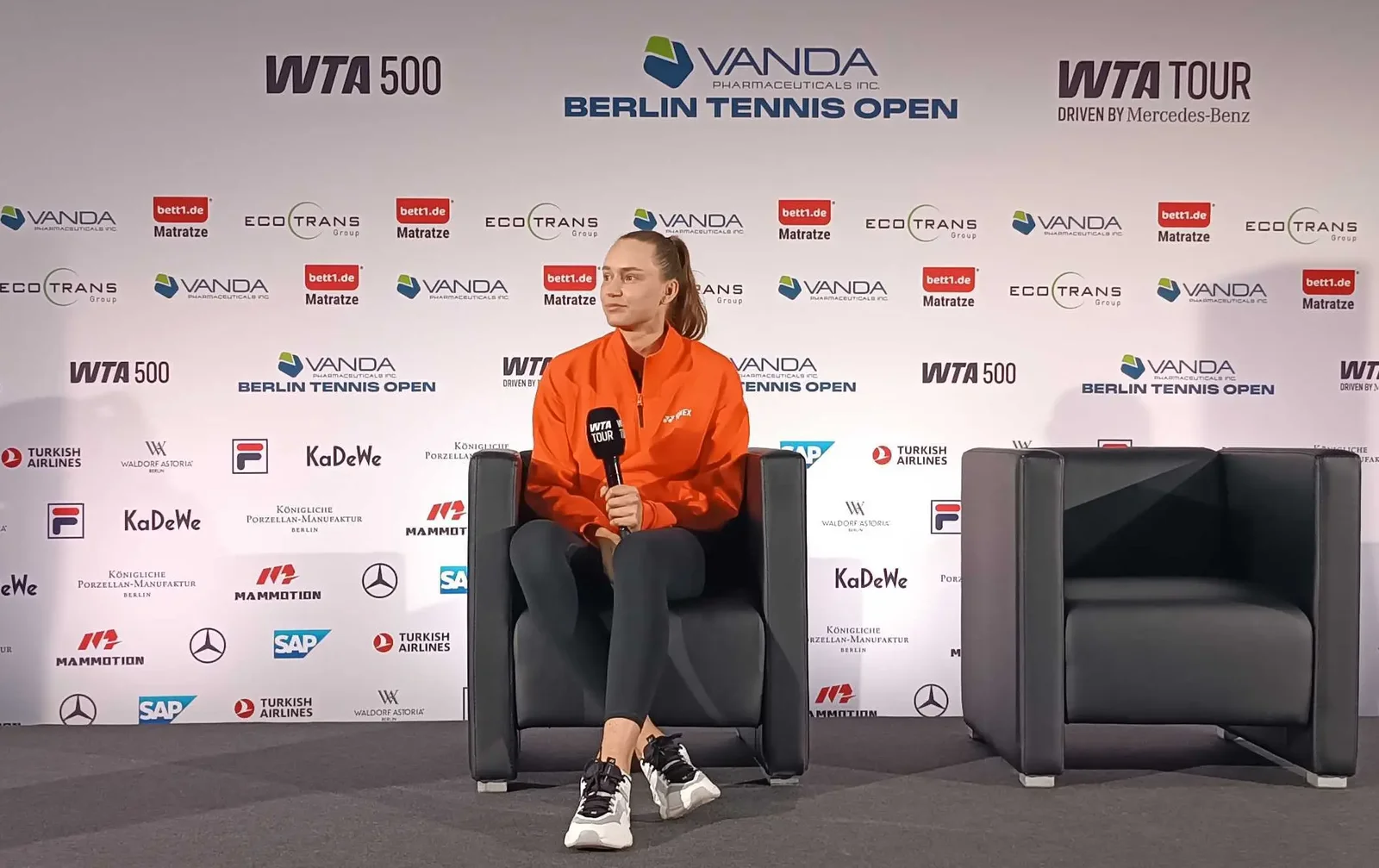
World No. 2 Elena Rybakina, the 2022 Wimbledon champion, met the press in Berlin with the No. 1 ranking back within range. By TennisRatio's projection, once the points both players are defending through Wimbledon are stripped out, she and Aryna Sabalenka sit almost level at the top, and the serve doing much of the work for her leads the tour. Rybakina, though, kept the ranking talk at arm's length. TennisRatio asked her about that race and about the numbers behind it.
Rybakina plays down the chase for No. 1
TennisRatio: It looks like the WTA ranking situation will be very close in the coming weeks. How much do you look forward to chasing the No. 1 spot, knowing your game suits grass so well and you have such a strong record on the surface?
"I don't think about it so much, because recently the results haven't been the greatest for me. So I'd say that right now it's important for me to just take my time. There are so many good players, you need to focus on yourself, and then whatever happens, we'll see."
Rybakina leans on a serve that tops the tour
TennisRatio: During the current ranking period you hold the best rate of service games won and first-serve points won on tour. How much confidence does your serve give you on grass, as such a powerful and effective weapon?
Over the last 52 weeks on the main tour, Rybakina has won 83.7 percent of her service games and 74.2 percent of her first-serve points, the leading figures in both categories by TennisRatio's tracking, a base that counts for most on a surface where the serve carries.
"On grass the serve is really important, and if I have a high percentage then of course I'm more confident, and you try to get as many opportunities on the return. That's something where I still need to improve and do better, but on such a surface the serve is really important and it can help in the important rounds."
Rybakina builds match play across a full grass run
You entered all three grass weeks before Wimbledon, which is unusual for a top player. Were you trying to bank points or matches?
"I went out of my earlier tournament quite early, so I had plenty of time to play my first event in London, and being here is always fun, I always have. For the next one I'll see how I feel. On grass you can't really practice much, you need to play more matches and then you might feel better. Plus, with our schedule and the rule that you need to play six events, it's not always easy to fit them all in, and I'd rather do that on grass than try to add more at the end of the season, when you might be more tired or not ready physically. So for now it's like this, and hopefully it really helps me play better at Wimbledon."
Rybakina points to health and consistency as the difference
What do you think you need to keep your level high week after week to stay among the best?
"I need to be physically strong, of course, and to stay consistent and take my opportunities. In a lot of matches I have chances to break, to win in straight sets, and instead it becomes a very difficult match. So stay healthy first, then keep playing, keep fighting. Consistency is the most important thing."
Rybakina revisits last year's quarterfinal against Sabalenka
A year ago you had a dramatic quarterfinal here against Aryna Sabalenka, with several match points that didn't go your way. What are your memories of that match, and what do you think happened in those moments?
"I don't remember if it was four in the tiebreak, it was one before and three in the tiebreak. We both played aggressive and I got the lead, but it changed quickly. One net cord, one mistake from my side, and once the tiebreak got even I lost my chance in the match. But I've played many years here, so I have a lot of memories from this tournament."
Rybakina explains stepping back from social media
After your loss in London last week you briefly deactivated your Instagram and brought it back with restrictions on the comments. What is it like for one of the best players to deal with social media negativity after losses?
"It's impossible to control it any other way, and of course it's not the nicest thing. I usually don't pay much attention, but at that point it felt important. A lot of it is connected to the job, and I felt that if these people can't stop in the moment because they lost some money, I'd rather give the option to comment nothing and then bring the account back. I'm not there to spend all day cleaning my Instagram. I have a little help with the content, but it's not full-time. So I thought it's better even for me to spend less time on social media."
She added that she has kept limits on her usage for a long time. "Sometimes you don't even notice, and it becomes too much of your time. For me it's ok not to be on social media, and if I weren't a public figure, I don't think I'd post much or do a lot on it." Asked whether anything would change going forward, she said she had learned "a lot," and would "just limit all the limits."