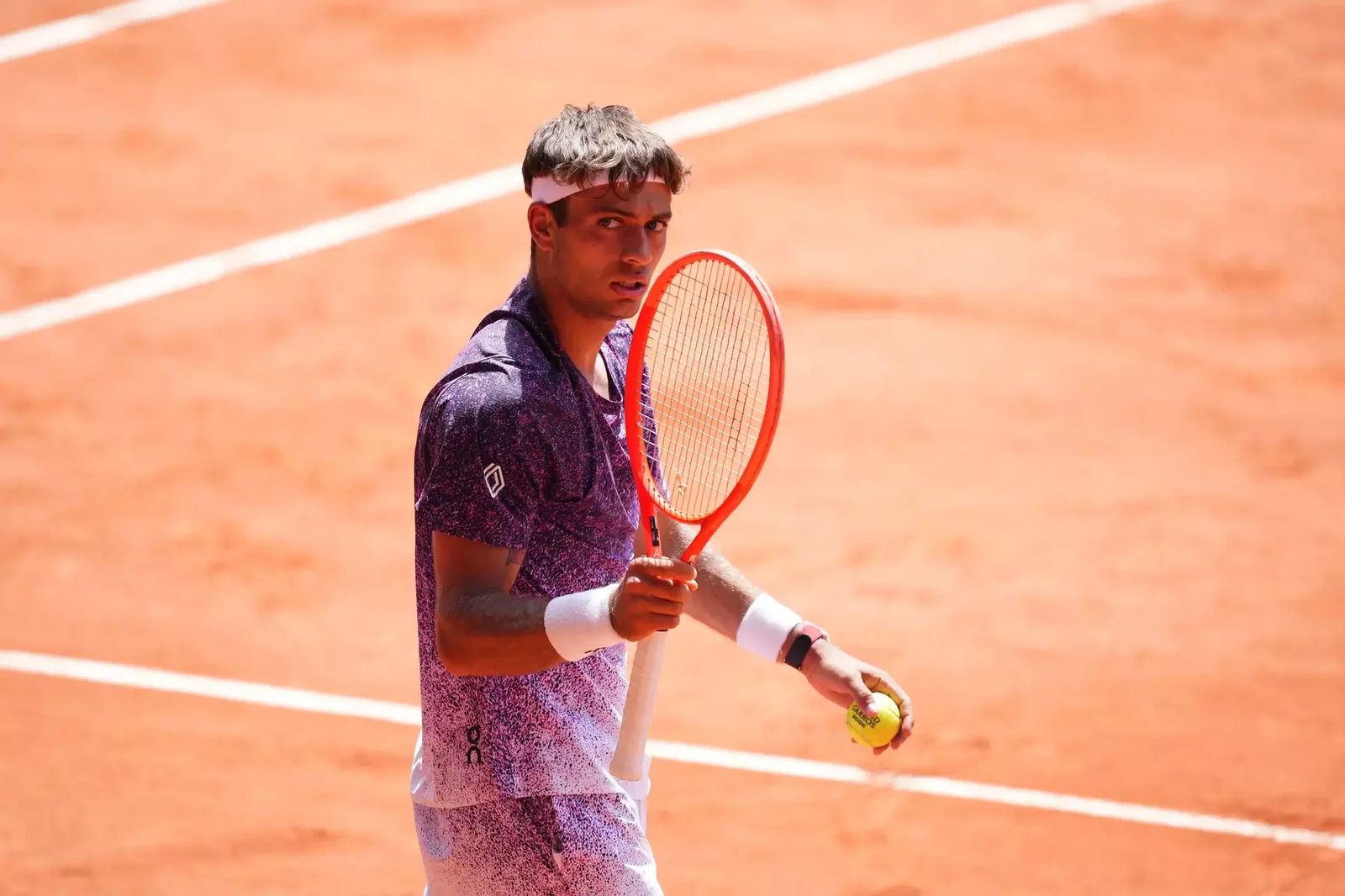
When the tournament began, few would have predicted this final. Yet after two weeks of surprises, upsets and shifting narratives, Roland Garros 2026 arrives at a fascinating conclusion. On one side stands Alexander Zverev, the world No. 3 and the man who suddenly became the overwhelming favorite once Jannik Sinner's shocking second-round exit opened up the draw. On the other is Flavio Cobolli, who has embraced the chaos rather than feared it, openly speaking throughout the fortnight about the opportunity of a lifetime. For Zverev, this is the fifth Grand Slam final of his career and perhaps the most favorable chance he has ever had to finally lift a major trophy. For Cobolli, it is uncharted territory: a first Slam final, a Top 10 debut already secured and a tournament that has transformed him from dangerous outsider into genuine contender. One arrives carrying the weight of history, the other with seemingly nothing to lose.
Zverev: one more chance
Few players have spent longer chasing a first Slam title than Alexander Zverev. The German arrives in Paris on an 18-4 clay season in 2026, the form of a man who has handled the surface as well as anyone left in the draw. He has dropped only two sets during the tournament, against Quentin Halys and Jakub Mensik, and has generally looked composed, physically strong and tactically sharp. The semifinal against Mensik followed a familiar pattern. Zverev escaped danger in a tight opening set, raised his level once ahead, survived a temporary dip in the third and quickly reasserted control when the match threatened to become complicated. It was the performance of a player determined not to repeat past mistakes. Yet those past mistakes remain impossible to ignore. The scars of Grand Slam finals still accompany him. The most painful remains the 2020 US Open, where he led Dominic Thiem by two sets before losing. The defeats to Carlos Alcaraz in the Roland Garros final of 2024 and Jannik Sinner at the Australian Open of 2025 hurt less because the opponents were exceptional, but they still extended the wait. This is why Sunday feels different: for the first time in years, Zverev walks onto a Slam final court as the clear favorite. There are small reasons for concern. Curiously, his last six defeats have all come against Italians, including one to Cobolli himself in Munich earlier this season. And while his diabetes has rarely been an issue during this tournament, a long physical battle could potentially test his endurance. Even so, the German remains the player with more experience, more firepower and more proven success at this level.
Cobolli: the opportunity of a lifetime
Cobolli's path could hardly be more different. The 2002-born Italian becomes the first player from his birth year to reach a Grand Slam final, and he has done so with a refreshing attitude. While many players avoid discussing expectations, Cobolli has repeatedly acknowledged the opportunity in front of him, appearing energized by it rather than intimidated. The Roman has lost only two sets all tournament, against Zachary Svajda and Felix Auger-Aliassime, and arrives fresh after Matteo Arnaldi's withdrawal from their scheduled semifinal due to illness. His reward is already substantial: a Top 10 debut and the biggest result of his career. A victory on Sunday would elevate him all the way to No. 5 in the ATP rankings. What makes Cobolli dangerous is that his improvement has not been based on emotion alone. The clay-court season has revealed a more complete player, one whose serve has become a genuine weapon, the wide slice generating the angles that have been crucial throughout Paris.
By the numbers: where the final is won
The two know each other well, and the ledger favours Zverev: he leads the head-to-head 3-1, with three of the four meetings on clay and all of them recent. Cobolli's one win is the one he will hold onto - a 6-3 6-3 upset in the Munich semifinals this year, his first victory over a top-three player. The broader pattern frames the scale of the task: Cobolli is 3-8 against top-10 opponents over the past 52 weeks and 4-18 for his career.
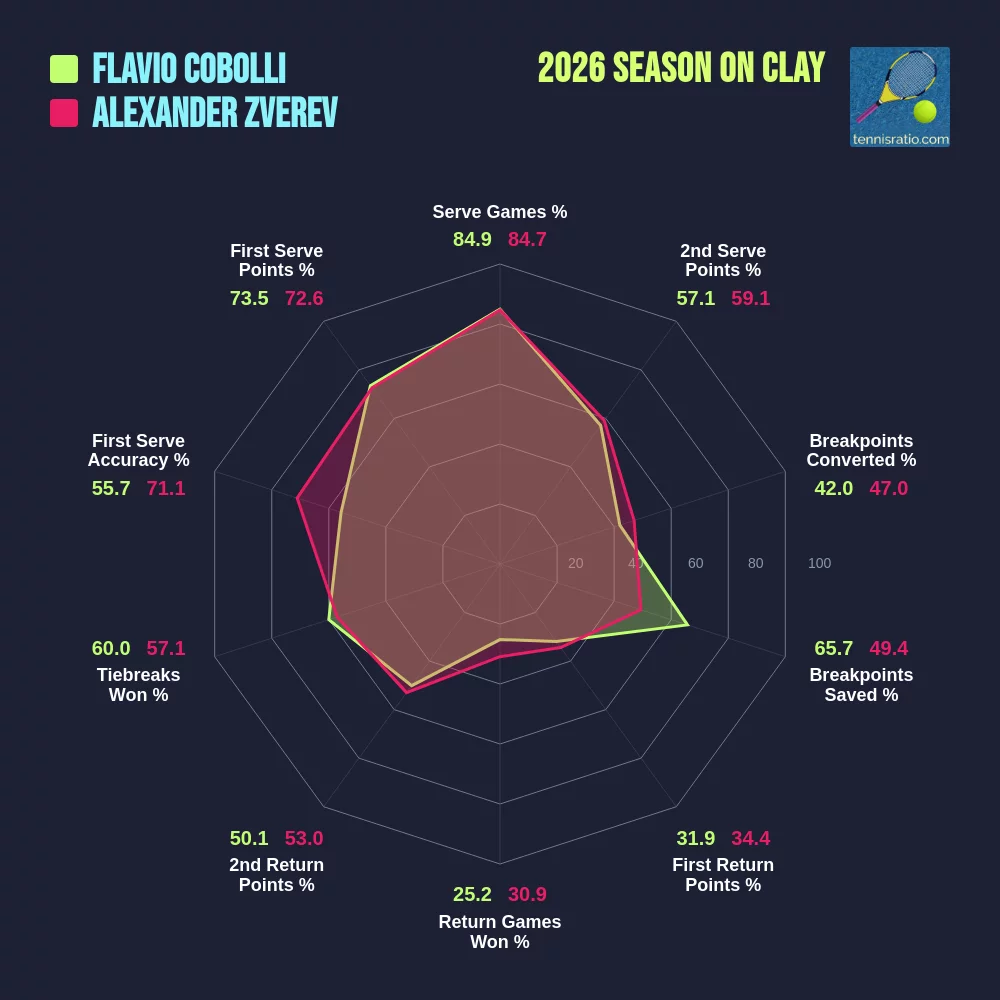
The season radar makes the match look closer than the head-to-head does, the two near-level on serve: their serve-games holds are all but identical at 84.9% to 84.7%, Cobolli edges first-serve points won (73.5% to 72.6%) and break-point defence (65.7% to 49.4%, a 16-point gap), while Zverev answers with first-serve accuracy (71.1% to 55.7%) and second-serve points (59.1% to 57.1%). On return Zverev grades higher across the board and converts more break points, 47.0% to 42.0%.
Measured against the full ATP clay field this season, the percentiles sharpen where each man stands - and where the daylight is. Zverev's serve grades out elite almost everywhere: first-serve accuracy in the 95th percentile, second-serve points in the 96th, service games held in the 91st. His return is the more striking part, strong and balanced in a way few big servers manage, every category around the 90th percentile and return games won as high as the 94th. The single glaring exception is break-point defence, a genuinely poor mark and the clear soft spot in his game - the one place a returner can hurt him, and the one statistical opening Cobolli has. Cobolli's own profile is built on two pillars, second-serve points and service games held, both in the 93rd percentile, undercut by a first-serve accuracy that grades near the bottom of the field. His return is respectable without threatening Zverev's - first-serve return in the 77th percentile, return games won in the 74th, break-point conversion in the 70th - solid marks that are nonetheless behind the German on every single return measure.
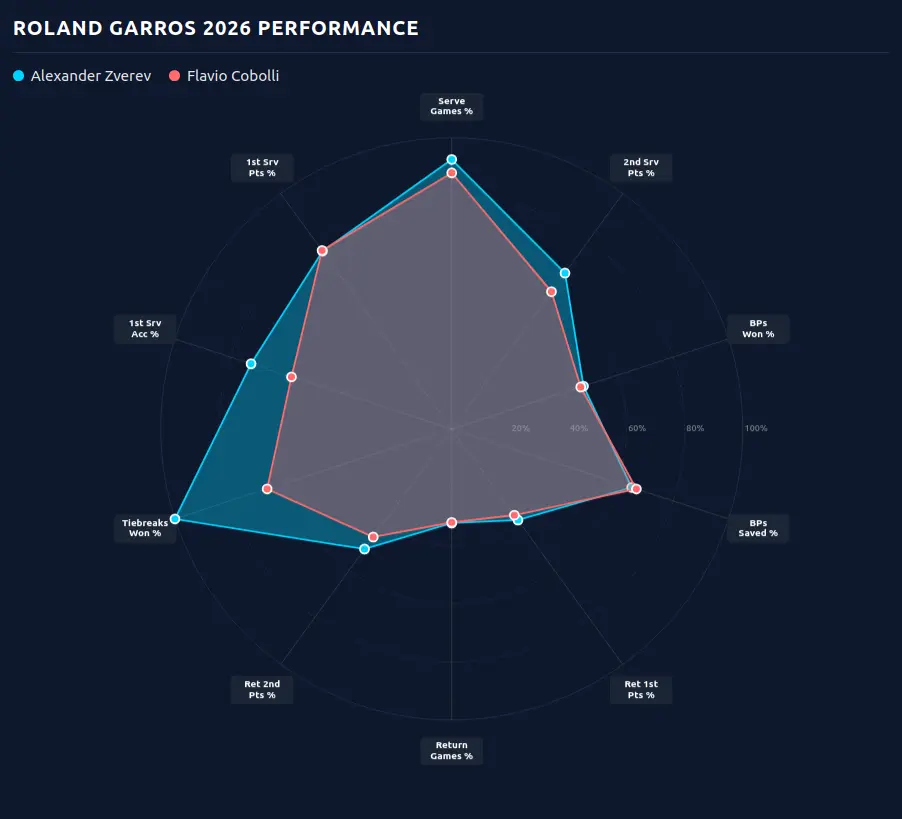
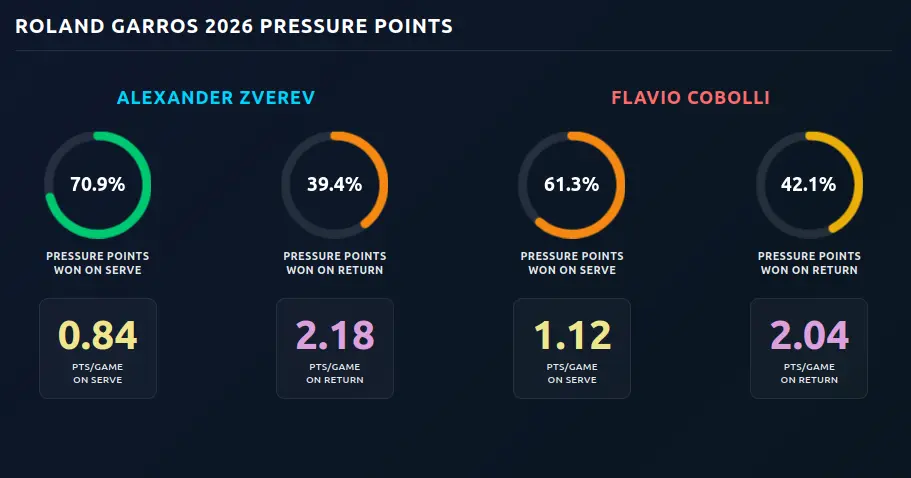
The Roland Garros-only layer, though, is where the gap opens, and it sits on serve. Zverev has been close to untouchable on his own delivery here - holding 92.6% of his service games to Cobolli's 88.0%, winning 66.2% of second-serve points to 58.3% - and the pressure-points volume tells the starker story: he has faced just 0.84 pressure points a game on serve, the lowest figure of anyone in this draw by some margin, the signature of a player whose holds have barely been contested for two weeks. Cobolli's task is to manufacture chances against a serve that has given up almost none, and the return numbers offer him little: the two have been near-identical returning (32.3% of return games to 32.1%), but Cobolli has generated slightly less pressure on return, 2.04 points a game to Zverev's 2.18, while having far more work to do. His own serve has leaned on a first ball that has landed only 57.9% of the time in Paris, dropping him onto a second serve where he wins 58.3% of points - and Zverev returns second serves better than anyone left. Where the season radar flattered Cobolli on break-point defence, the Paris numbers have evened even that, the two now level at 66.7% to 65.0%.
Tactical keys
If Cobolli is to pull off another upset, much of the battle may revolve around the forehand exchanges. Zverev's backhand remains one of the most reliable shots in the sport, but his forehand can occasionally become vulnerable when opponents force him to defend while moving. Cobolli's heavy forehand and excellent wide serve could allow him to repeatedly attack that side of the court, dragging the German away from his preferred positioning and creating openings for first-strike tennis. The Italian's challenge will be sustaining that aggression for potentially four or five sets. Against most opponents he has been able to dictate large stretches of play. Against Zverev, those opportunities will be far rarer. For the German, the formula is simpler: serve well, use his superior backhand stability to control baseline exchanges and force Cobolli to hit one extra shot under pressure. If the match becomes a physical, tactical battle, the numbers and experience still point in his direction.
Head-to-head
The pair have met four times, with Zverev leading 3-1. Their most relevant meetings came this spring. Cobolli stunned the German in straight sets on the clay of Munich, while Zverev gained revenge weeks later in Madrid, 6-1 6-4. Their only previous meeting at Roland Garros came in 2025, when Zverev won comfortably in straight sets, 6-2 7-6(4) 6-1. The rivalry may be young, but both players know exactly what to expect.