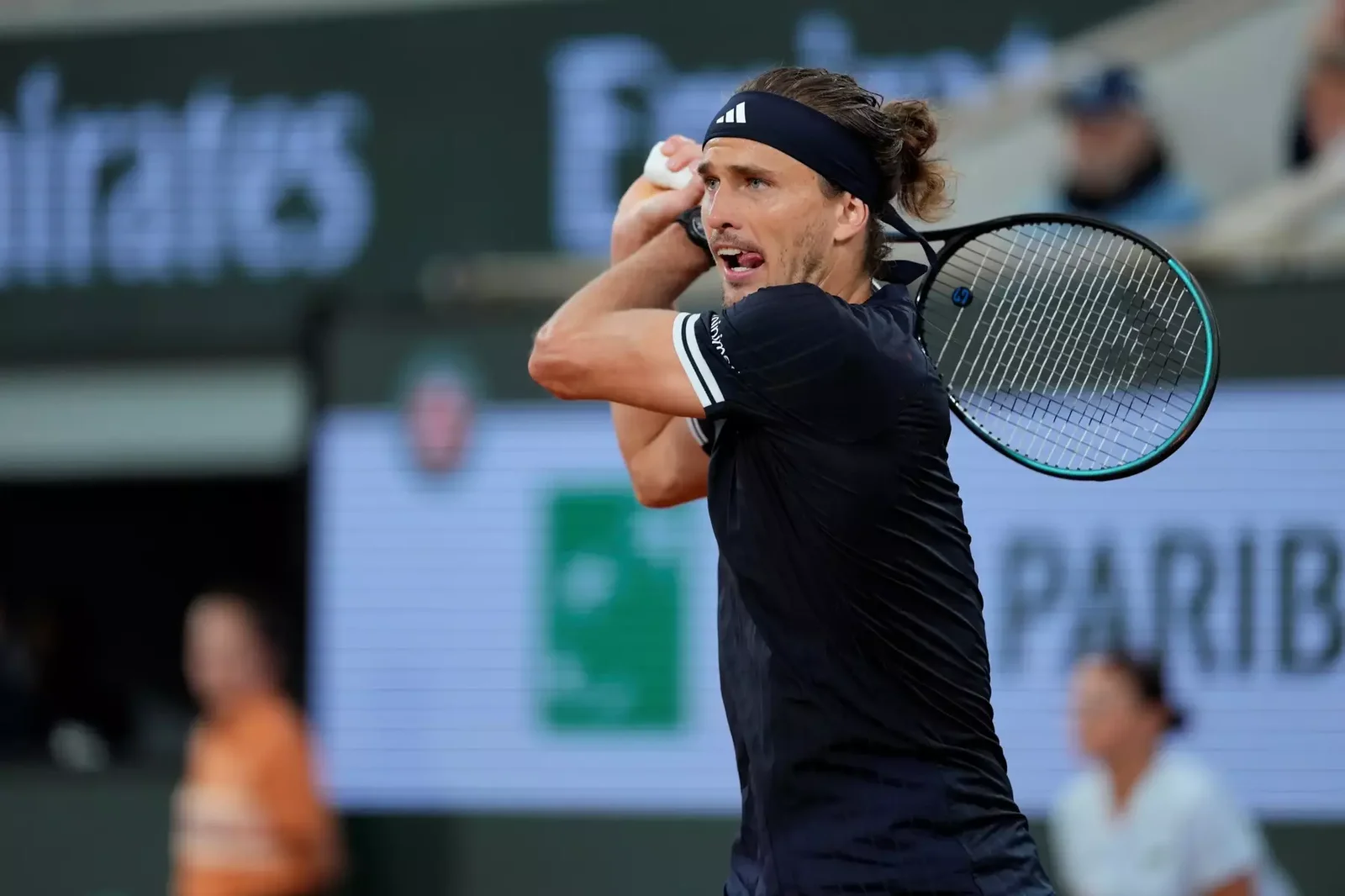
The men's draw that lost Jannik Sinner, Carlos Alcaraz and Novak Djokovic delivers a Friday semifinal lineup nobody could have drawn in advance: an all-Italian last-four meeting between two first-time major semifinalists, and the one proven name left in the field against a 20-year-old reaching this stage for the first time. Matteo Arnaldi faces Flavio Cobolli for a place in the final, while Alexander Zverev, the 2024 finalist, takes on Jakub Mensik. The numbers come in two layers throughout. The season figures show the form each man carried into Paris; the Roland Garros figures, drawn from these matches alone, show how they have actually played on this court over the fortnight - and in both semifinals the two diverge in ways worth reading.
Arnaldi and Cobolli meet in an all-Italian final eliminator
Three Italians reached the men's quarterfinals and none was named Sinner or Musetti; two of them now meet for a place in the final. It is a rematch of this exact stage of the calendar a year ago, when Cobolli beat Arnaldi in the Roland Garros third round in four sets, 6-3 6-3 6-7(6) 6-1, though across their careers Arnaldi leads the head-to-head 3-2. Cobolli reaches a first Grand Slam semifinal off a comeback from a set down against Felix Auger-Aliassime, 4-6 6-4 6-4 6-4, the breakthrough fortnight of his career on a 14-5 clay season, and he has done it as the fresher man, dropping few sets and never dragged into a fifth. Arnaldi's road has been the opposite, the strangest in the draw: the most court time any man has logged reaching a major quarterfinal in the professional era, including five-set wins over Tallon Griekspoor, Raphael Collignon and Frances Tiafoe, the last two each running close to or beyond five hours. Only a quarterfinal cut short by Berrettini's second-set retirement - Arnaldi a break up at 7-5 5-2 when the former finalist's body gave way - spared his legs a fifth long match. He is 7-3 at tour level on clay this year, and the fitness gap between the two is the subplot the draw has written.
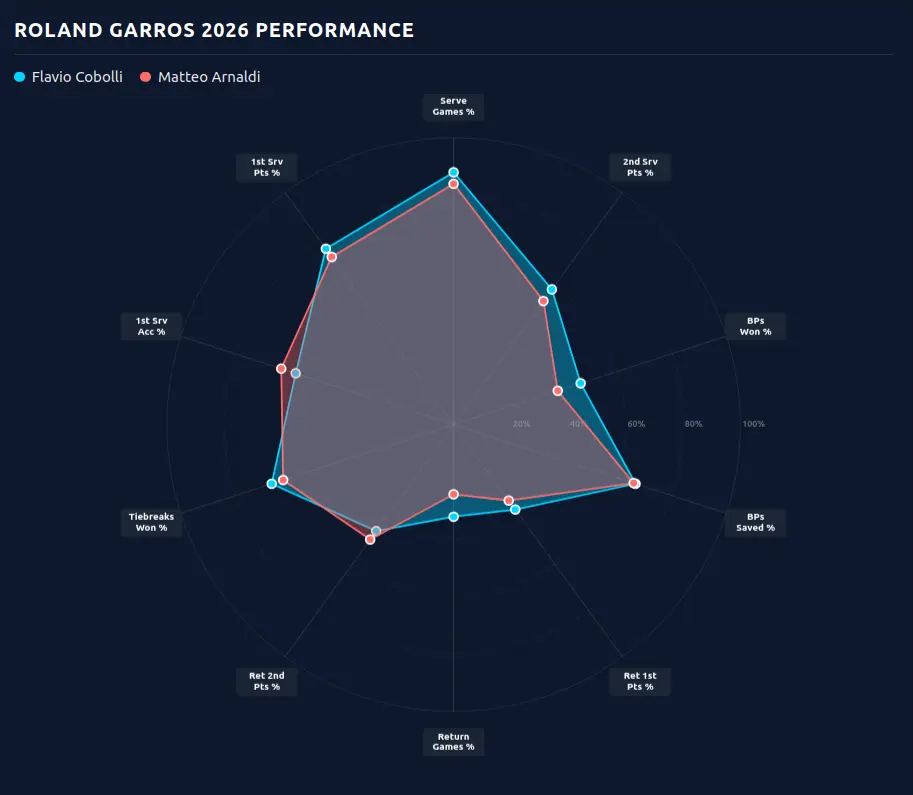
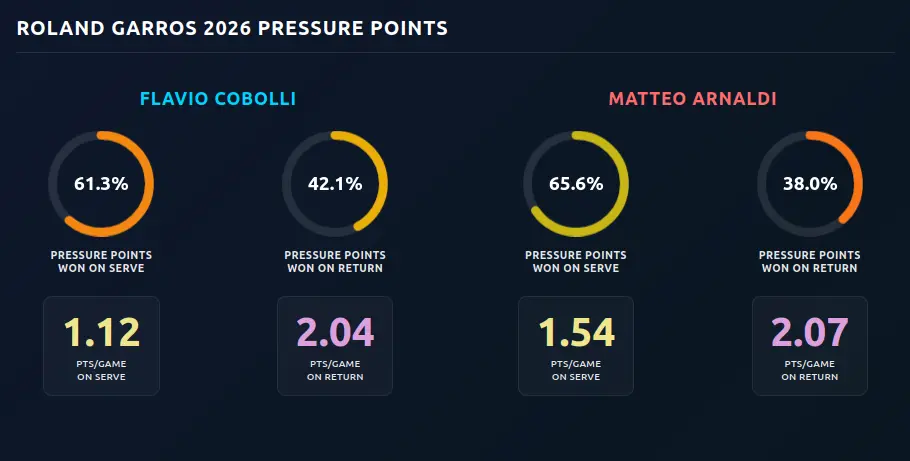
Across the season the radar makes this Cobolli's serve against a coin-flip return battle. He holds 84.9% of his service games to Arnaldi's 77.1%, wins 73.5% of first-serve points to 70.0% and 57.1% of second-serve points to 50.2%, and saves break points at 65.7% to 57.8%, while their return rows sit almost level - first-serve return points 32.4% to 31.9%, break-point conversion 42.0% to 40.9%. Restricting both men to these five Paris matches keeps Cobolli ahead on serve (88.0% of service games held to 84.0%) but widens what was a level return battle into a clear Cobolli edge: he has won 32.1% of his return games here to Arnaldi's 24.3% and converted 46.6% of his break points to 38.2%. That reading carries a caveat - Arnaldi's Paris sample is distorted by opponents who broke down physically, Berrettini's retirement among them, so his returning numbers flatter the resistance he actually overcame. But on serve, the part of the game least dependent on the opponent, the gap is real and consistent across both layers: Cobolli has been the cleaner, heavier server all year and again in Paris, where Arnaldi's relative weakness has been the cheap points he leaks, a tour-high-for-this-pair 3.4 double faults a match against 6.7 aces.
Zverev meets Mensik with experience against a breakthrough
Alexander Zverev is the last man standing who has been this deep before - a Roland Garros finalist in 2024, into the semifinals on an 18-4 clay season, and the favourite by every measure the draw still offers. He leads the head-to-head 1-0, the meeting recent and on this surface: a three-set Madrid win this season, 6-4 6-7(4) 6-3. Mensik, 8-3 on clay, reaches a first major semifinal as the 2025 Miami champion finally carrying his hard-court game onto the dirt, having come through a five-set quarterfinal that confirmed the breakthrough.
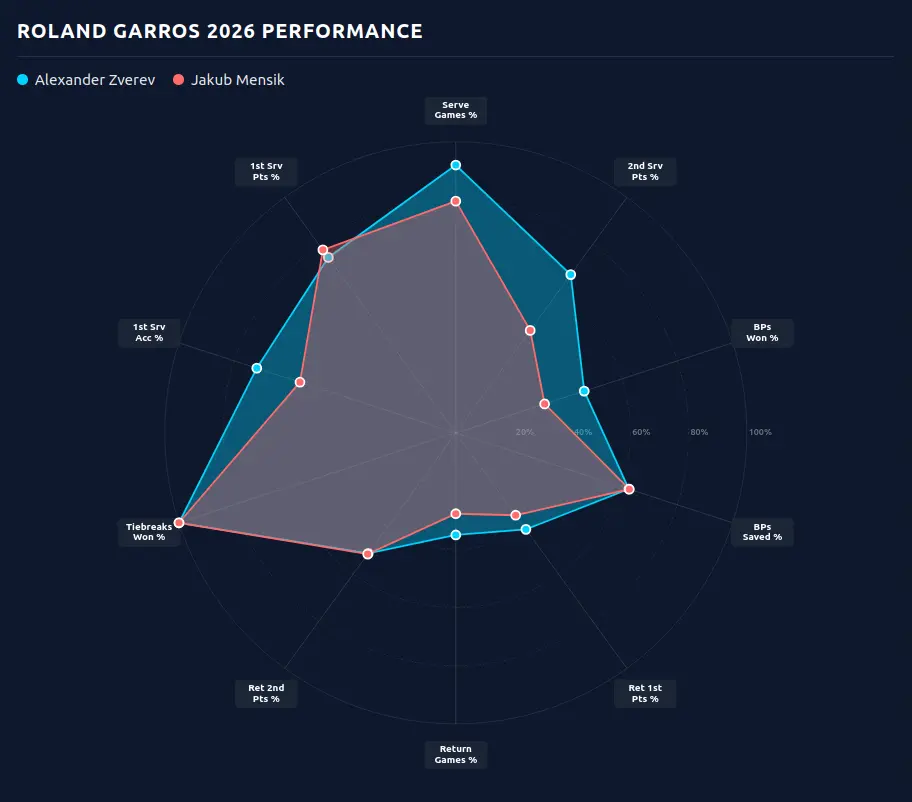
The season radar gives Zverev the edge in most departments and decisively where it counts - 58.9% of second-serve points to Mensik's 47.1%, 46.6% of break points converted to 30.3%, and clear margins across the return rows. Measured against the full ATP clay field this season, the percentiles expose the fault line in Mensik's game: his first-serve points won grade out in the 98th percentile, elite and close to untouchable when the first ball lands, but his second-serve points sit at the 27th, a chasm within a single player. Zverev is built to attack precisely that - his own second-serve points rank in the 86th percentile, and his returning of second serves in the 90th. The one season figure that ran Mensik's way was break-point defence, where he saved 60.3% to Zverev's 48.2%, the soft spot in the German's game all year.
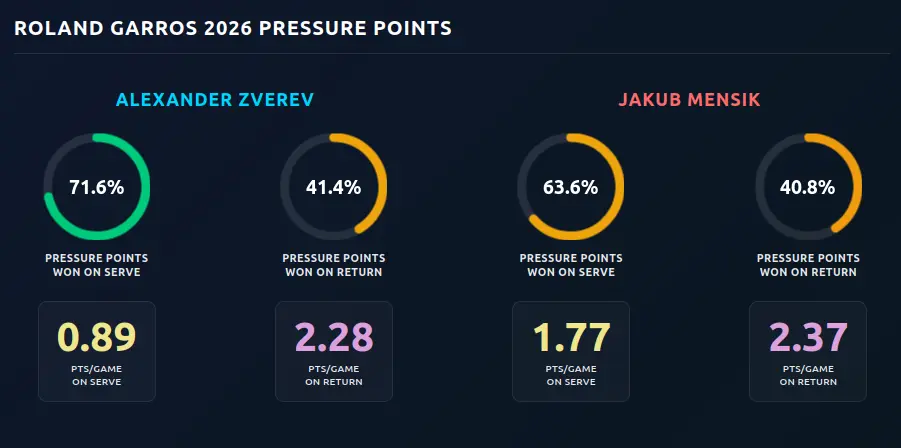
The Paris layer is where that last point shifts. Across these matches the two are level on break points saved, 62.5% to 62.7%, Zverev having patched his season-long weakness while holding an extraordinary 92.0% of his service games here to Mensik's 79.6%, and winning 67.2% of his second-serve points to 43.5%. The mechanism of the match follows from all of it. When Mensik's first serve is landing he is close to unplayable; when it misses - and his first-serve accuracy in Paris has been just 56.3% to Zverev's 71.9% - he drops onto a second serve that has been his weakness all season, across the net from the best second-serve returner left in the draw. Zverev's path is to make him play that second ball as often as possible.


