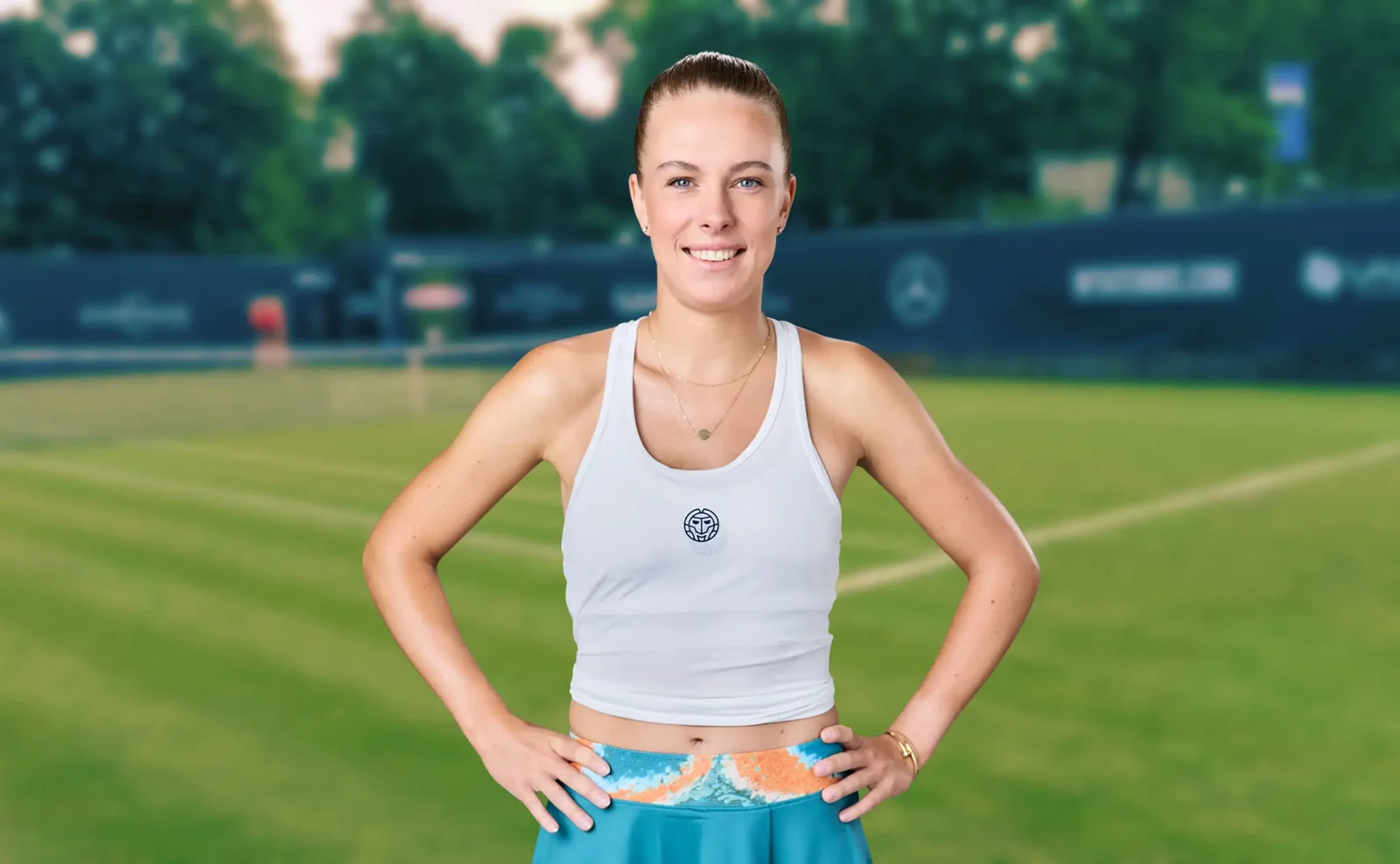
Magdalena Fręch arrived in Berlin still working her way back from a muscle injury, more gym than court, and treated the week as a first step back on grass rather than a statement. Her opening match still turned into the kind of fight she says she relishes: two match points saved in front of a crowd packed around court number 2, the venue's only court without seating. We spoke with the Pole about the bite she wants back in her game, the seeding at the biggest tournaments she is chasing, and the pressure she admits comes from no one but herself.
Returning from injury and saving two match points
Let's start with the positives. It's worth beginning with what happened on Saturday, when you saved two match points and advanced. That's already the third time this season you've come out of a situation like that. Above all, how much satisfaction do wins like that give you?
First of all, it was my first match after coming back, because I hadn't played for a long time after Roland Garros. I had a break, because muscle injuries are very tricky. If you return to training and loads too quickly, unpleasant complications can show up later. So there was definitely too little training strictly on grass, and I spent more time in the gym. I treated this tournament as a warm-up then, a first step onto grass and a chance to get some practice on the surface.
Fighting to the last ball through long battles
Everyone knows that fighting spirit is one of your greatest strengths, but I get the impression that your matches are increasingly turning into real thrillers for the fans. We saw it especially on Saturday, when a real crowd gathered around court number 2 in Berlin, even though it's the only court at the venue without seating. There's an interesting statistic that says in the 2025 season you played 7 matches longer than 2.5 hours, and this year, even though it's only June, there have already been 9 such matches. Where does the strength and the ability to find yourself in such long, exhausting battles come from?
I'd like that to come back, for there to be more of that bite. Of course not every match goes the way I'd want, but it matters to me that the will to fight is there until the last ball. In my recent matches there were a bit too many emotions and I wasn't quite myself. I hope I'll improve that balance this year and there will be more of those hard-fought duels, because it's something I enjoy. And along the way I give my coach grey hairs [laughs], which is my favourite pastime.
Chasing a Grand Slam seeding and staying in the elite
You mentioned that short run-up before the grass season. As it happens, grass is an environment where you could say a certain breakthrough took place in your career. In June 2023 you reached two quarterfinals, in Nottingham and Birmingham. Before those tournaments you had spent some time mainly around the end of the top 100, and that period let you move up to the top 70. Practically from then until today you've stayed in the wider WTA elite. Hence the question: in your view, what is the key to that stability? We know all sorts of unpleasant things happen, injuries, defending ranking points, and yet you're still here, in this wider top tier.
First of all, looking at my career from the outside, from the very beginning I dreamed about getting into the Top 100 first, and later the Top 50. Those were goals and dreams that, once I reached them, were supposed to make me very happy. But of course, when you achieve something you want more and more, and tennis doesn't forgive, it's a constant chase for points, for ranking. You always want more, there isn't that satisfaction you should have, at least for a moment.
It's certainly not easy, the competition runs all the time, and really a week or two without playing can mean you drop out of the top tier and lose ranking spots. It's definitely a challenge and it's hard, although I think I'm capable of more and I'd certainly like to fight for seedings at the biggest tournaments. A ranking inside the top 32 already guarantees seedings at the Grand Slams, and that's my main goal to focus on this season. I was in that top 32 throughout the year, so I know it's realistic. I'm definitely looking forward more than back, and we know that staying near the top is decided at the bigger tournaments, where there are more points to win, so the key is to play well at the mandatory tournaments, because they are largely what lets you stay in the top 50.
Easing the pressure she puts on herself
We started with the positives, so let's also finish on a positive note. I mentioned that fighting spirit, that it's a quality everyone sees in you on court. But is there also some aspect of your game, or a quality of yours as a player, that you might consider overlooked and yet a real strength of yours?
Of course, at this moment it's probably hard for me to talk about positives after two losses in a row. We very often define ourselves by what happens in our most recent matches, rather than by what came before. I'd certainly like to find a bit more joy in playing and once again draw more happiness from being on court. I think that at times I put too much pressure on myself, because of course I'm the one in command of myself and the one imposing that pressure, not anyone from the outside. Sometimes it's very hard to take it off and lower my expectations, and I hope that's exactly the direction I'll go in.
This interview was conducted by Maciej Myrta, founder of TennisRatio.com, during the WTA Berlin Tennis Open on June 16, 2026.
Magdalena Fręch przyjechała do Berlina wciąż wracając po kontuzji mięśniowej, z większą liczbą godzin na siłowni niż na korcie, i potraktowała ten tydzień jako pierwsze wejście na trawę, a nie próbę udowadniania czegokolwiek. Mecz otwarcia i tak zamienił się w pojedynek, jaki sama lubi: dwie obronione piłki meczowe przy kibicach ściśniętych wokół kortu numer 2, jedynego na obiekcie bez miejsc siedzących. Rozmawialiśmy z Polką o pazurze, który chce odzyskać w swojej grze, o rozstawieniach w największych turniejach, o które walczy, i o presji, która, jak sama przyznaje, nie bierze się od nikogo poza nią samą.
Powrót po kontuzji i dwie obronione piłki meczowe
Zacznijmy od pozytywów. Na pewno warto zacząć od tego, co wydarzyło się w sobotę, kiedy obroniła Pani dwie piłki meczowe i awansowała dalej. To już trzecia taka sytuacja w tym sezonie, kiedy wyszła Pani z takiej opresji. Przede wszystkim, jak dużo satysfakcji dają takie zwycięstwa?
Przede wszystkim był to mój pierwszy mecz po powrocie, bo od Roland Garros długo nie grałam. Miałam przerwę, ponieważ kontuzje mięśniowe są bardzo newralgiczne: jeśli wróci się za szybko do treningów i obciążeń, później mogą pojawić się nieprzyjemne powikłania. Dlatego treningu stricte na trawie było zdecydowanie za mało, więcej czasu spędziłam na siłowni. Ten turniej potraktowałam więc jako przetarcie, pierwsze wejście na trawę i okazję do potrenowania na tej nawierzchni.
Wola walki do ostatniej piłki w długich bataliach
Wszyscy wiedzą, że waleczność jest jedną z Pani najmocniejszych stron, ale mam wrażenie, że Pani mecze coraz częściej dostarczają kibicom prawdziwych thrillerów. Widzieliśmy to zwłaszcza w sobotę, kiedy wokół kortu numer 2 w Berlinie zgromadził się prawdziwy tłum kibiców, mimo że to jedyny kort na obiekcie bez miejsc siedzących. Jest taka ciekawa statystyka, która mówi o tym, że w sezonie 2025 rozegrała Pani 7 meczów, które były dłuższe niż 2,5 godziny, a w tym roku, mimo że mamy dopiero czerwiec, takich meczów było już 9. Skąd się bierze siła i zdolność do odnajdywania się w tak długich i wyczerpujących bataliach?
Chciałabym, żeby to wróciło, żeby było więcej tego pazura. Oczywiście nie każdy mecz układa się tak, jakbym chciała, ale zależy mi na tym, żeby ta wola walki była obecna do ostatniej piłki. W ostatnich meczach było trochę za dużo emocji i nie do końca byłam sobą. Mam nadzieję, że poprawię ten bilans w tym roku i będzie więcej takich zaciętych pojedynków, bo to jest coś, co lubię. Przy okazji przyprawiam wtedy trenera o siwe włosy [śmiech], a to moje ulubione zajęcie.
Walka o rozstawienie w Szlemach i utrzymanie w czołówce
Wspomniała Pani o tej krótkiej rozbiegówce przed sezonem trawiastym. Tak się składa, że trawa jest środowiskiem, w którym można powiedzieć, że nastąpił pewien przełom w Pani karierze. W czerwcu 2023 roku dotarła Pani do dwóch ćwierćfinałów, w Nottingham i Birmingham. Przed tymi turniejami od jakiegoś czasu utrzymywała się Pani głównie w okolicach końca pierwszej setki, a ten okres pozwolił awansować do top 70. Właściwie od tamtej pory, do dzisiaj, ciągle utrzymuje się Pani w szerokiej czołówce WTA Tour. Stąd pytanie: jaki jest Pani zdaniem klucz tej stabilności? Wiadomo, że dzieją się różne przykre historie, kontuzje, obrona punktów rankingowych, a Pani cały czas jest tutaj, w tej szerokiej czołówce.
Przede wszystkim, patrząc z boku na swoją karierę, od początku marzyłam o tym, żeby wejść najpierw do Top 100, a później do Top 50. To były cele i marzenia, które, jak je osiągnę, miały sprawić, że będę bardzo szczęśliwa. Jednak wiadomo, że jak się coś osiągnie, to chce się coraz więcej, i wiadomo, że tenis nie wybacza i jest ciągłą gonitwą punktów, rankingu. Cały czas chce się więcej, nie ma tej satysfakcji, którą powinno się mieć chociaż na chwilę.
Na pewno nie jest to łatwe, rywalizacja biegnie cały czas i tak naprawdę tydzień, dwa tygodnie, kiedy się nie gra, może sprawić, że wylatuje się z czołówki i traci lokaty w rankingu. Na pewno jest to wyzwanie i jest to ciężkie, aczkolwiek myślę, że stać mnie na więcej i chciałabym na pewno zawalczyć o rozstawienia w największych turniejach. Wiadomo, że ranking top 32 już gwarantuje rozstawienia w Wielkich Szlemach i to jest mój główny cel, na którym będę się skupiać po prostu w tym sezonie. Przez cały rok byłam w tej 32-ce, więc wiem, że jest to realne. Na pewno bardziej patrzę w przód niż w tył i wiadomo, że o utrzymanie w czołówce gramy w większych turniejach, do zdobycia są większe punkty, więc kluczem jest dobrze grać w turniejach mandatory, bo to one w dużej mierze pozwalają utrzymywać się w top 50.
Mierzy się z presją, którą sama tworzy
Zaczęliśmy od pozytywów, więc skończymy również w pozytywnym tonie. Wspomniałem o tej waleczności, że to taka Pani cecha, którą wszyscy widzą na korcie. Ale czy jest też jakiś atrybut gry lub cecha Pani jako zawodniczki, którą może Pani uważać za niedostrzeżoną, ale jednocześnie za swoją bardzo silną stronę?
Wiadomo, że w tym momencie pewnie trudno jest mi mówić o pozytywach po dwóch porażkach z rzędu. Bardzo często definiujemy się tym, co dzieje się w ostatnich meczach, a nie tym, co było wcześniej. Na pewno chciałabym złapać trochę więcej radości z gry i ponownie czerpać więcej szczęścia z tego, że jestem na korcie. Myślę, że momentami sama nakładam na siebie zbyt dużą presję, bo wiadomo, że to ja jestem dla siebie głównodowodzącą i narzucającą sobie tę presję, a nie nikt z boku. Czasami jest bardzo ciężko ją zdjąć i zmniejszyć swoje oczekiwania, i mam nadzieję, że właśnie pójdę w tym kierunku.