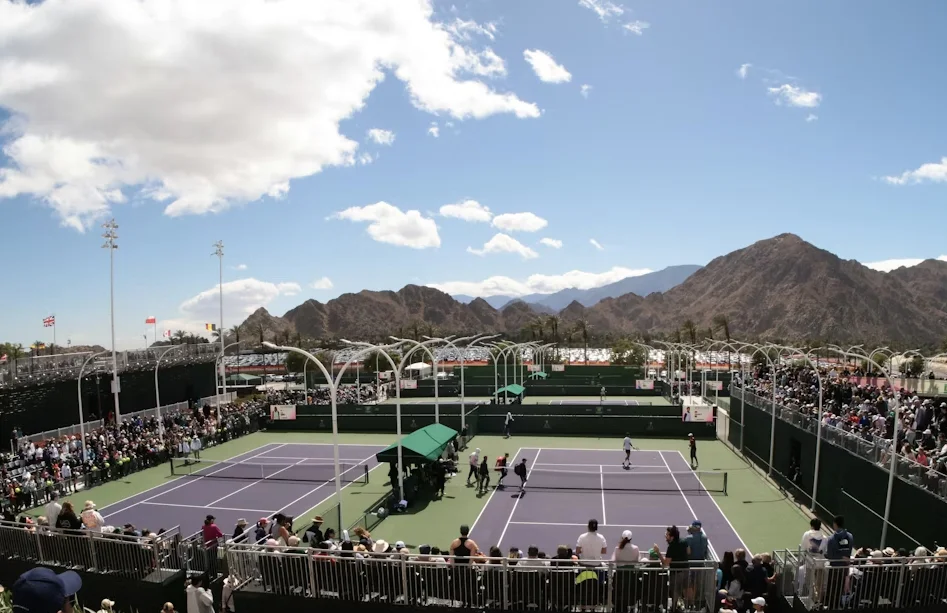
The BNP Paribas Open returns to Indian Wells with main draw action starting from 4th of March, bringing the ATP tour's first Masters 1000 event of the season to the California desert. The star-studded 96-player field features all top 10 players, headlined by world number one Carlos Alcaraz, who enters with a perfect 12-match winning streak in 2026 and dominant 38-4 hard court record over the past 52 weeks. Jannik Sinner arrives as the second seed despite a recent quarterfinal loss to Jakub Mensik in Doha, while Novak Djokovic continues his impressive veteran era after reaching the Australian Open final.
The draw sets up potential blockbuster semifinals with Alcaraz and Djokovic meeting in the top half, while a projected bottom-half clash between Alexander Zverev and Jannik Sinner could determine the other finalist. With Indian Wells historically favoring aggressive baseliners on its medium-fast or even slow hard courts, the tournament promises compelling storylines across all four quarters of the draw.
Quarter 1: Alcaraz wants to keep perfect 2026 record
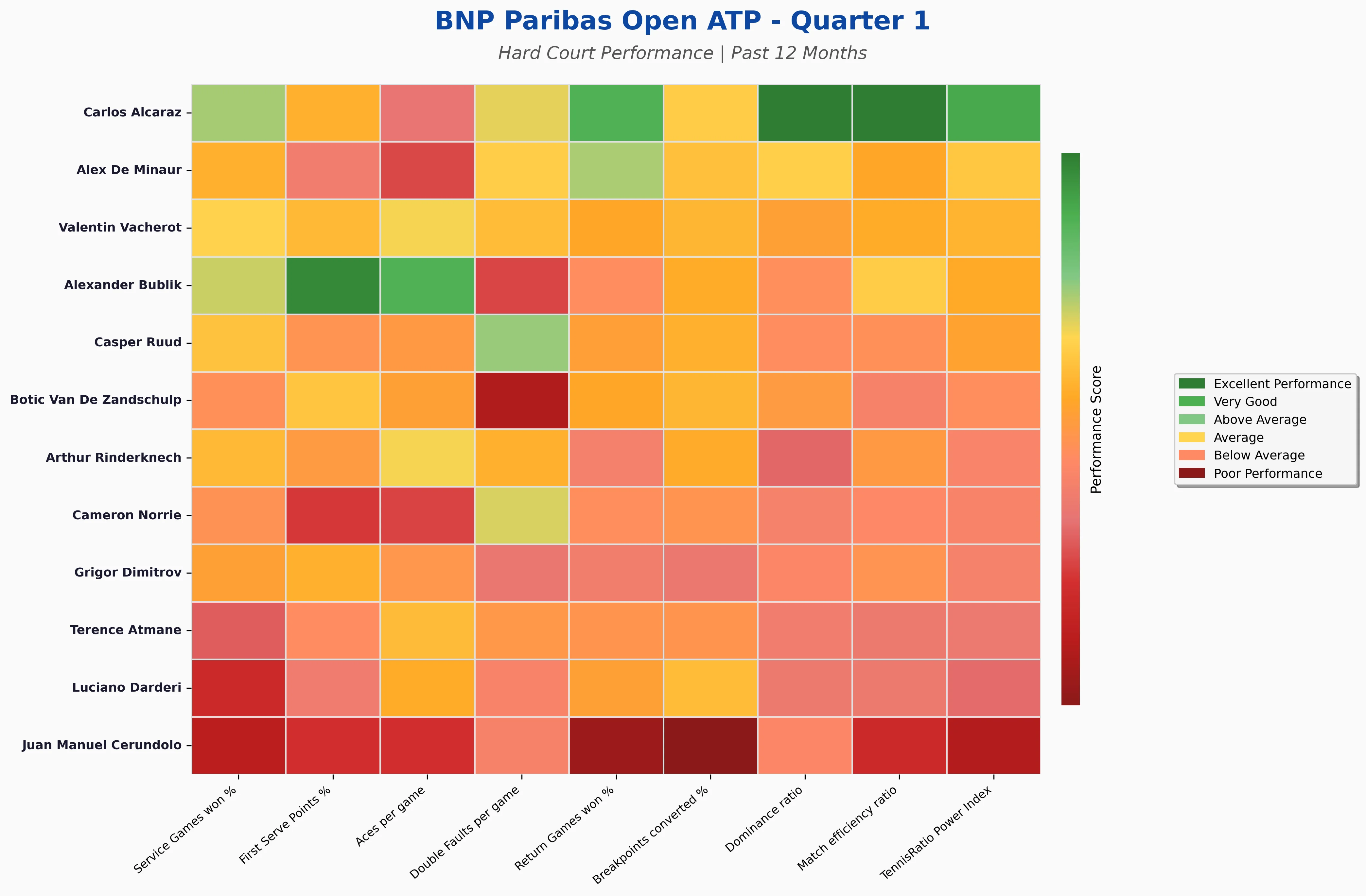
Top seed Carlos Alcaraz receives a first-round bye, but his draw looks interesting. The Spaniard will meet either Grigor Dimitrov or Terence Atmane in second round before likely facing 26th seed Arthur Rinderknech, whom he defeated 6-4, 7-6(5) in Doha just weeks ago. The Spaniard's 90.5% hard court win rate this season makes him the overwhelming favorite in a quarter that also features sixth seed Alex De Minaur and tenth seed Alexander Bublik. De Minaur brings excellent return metrics, winning 31.3% of return points against first serves, while his recent ATP 500 title in Rotterdam highlighted his improved consistency.
Thirteenth seed Casper Ruud enters with mixed recent form, holding a modest 5-5 record in his last ten matches. The Norwegian's 70.7% break point save percentage on hard courts provides some optimism, though his struggles against top opposition remain a concern. If seeds hold, the projected quarterfinal pits Alcaraz against De Minaur, a matchup that would be a festive of superior court coverage and return game from both top notch players.
The heatmap data reveals Carlos Alcaraz's dominance in creating match-winning opportunities, while Alex De Minaur excels at breaking serve and controlling rallies. Alexander Bublik is the huge serve-bombing threat, however his story of meeting the top flight players seem exposing his one-dimensional nature on court.
Quarter 2: Djokovic, Medvedev and serving merchants
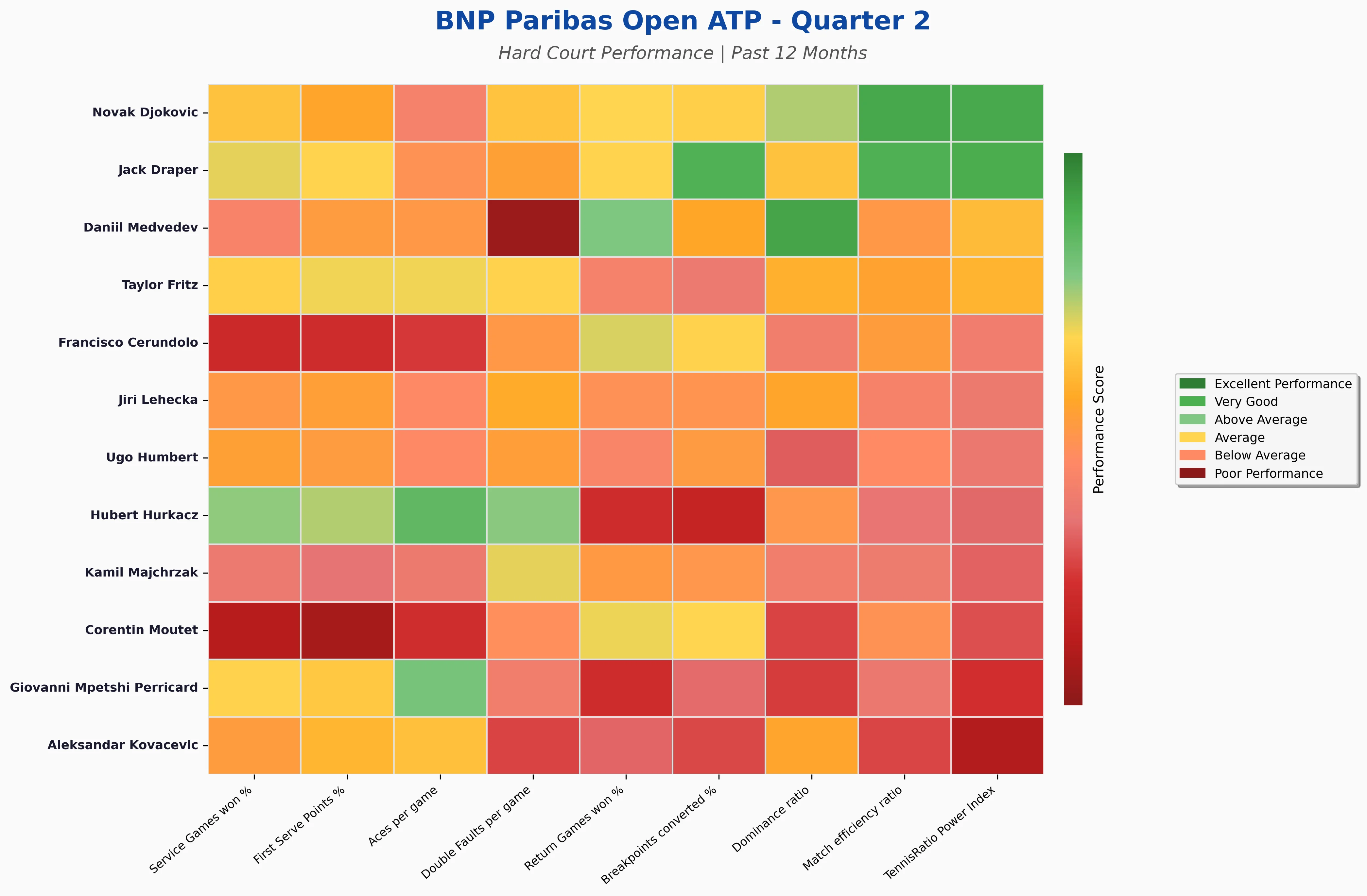
Third seed Novak Djokovic begins with a bye, positioning himself for what could be another deep Masters run. The Serbian's 82.1% hard court win rate reflects his continued excellence on this surface, supported by 76.5% first serve points won. The Serbian can meet Giovanni Mpetshi Perricard or Kamil Majchrzak in second round. The Frenchman still grows to the role of the strongest server in the ATP field, as he exceeds the average of 18 aces per match in his 2026 appearances. That not translates into efficiency of winning yet, but surely can be a tough test for anyone in early rounds. Djokovic's projected path includes a potential fourth-round meeting with fourteenth seed Jack Draper, who came back to competition after almost half year of absence with promising start in Dubai - losing narrowly to Arthur Rinderknech in second round.
Eleventh seed Daniil Medvedev as a freshly-crowned ATP 1000 Dubai champion, run highlighted by his commanding 6-4, 6-2 victory over Felix Auger-Aliassime in Dubai. The Russian's 33.6% return points won against first serves remains among the tour's best, making him dangerous against any opponent. Seventh seed Taylor Fritz completes the quartet's top seeds, though his 67.6% tiebreak record provides confidence in tight moments despite recent struggles in best-of-three encounters.
Novak Djokovic shows exceptional efficiency in converting statistical advantages into victories, while Jack Draper demonstrates strong clutch performance under pressure in the limited sample of his matches from last 52 weeks. Taylor Fritz's average run of form from recent months has dimnished his serving dominance in the field. Hubert Hurkacz is the one to watch once his form arrives well - being a super efficient serving player once fit. Hurkacz can be Djokovic's opponent in Round of 32 in case of defeating Aleksandar Kovacevic and Corentin Moutet later on.
The top half semifinal would likely feature Alcaraz against Djokovic, reprising their all time-epic Australian Open semifinals encounter where the Spaniard prevailed in five sets. Their 5-5 career head-to-head adds intrigue to what could be the tournament's most compelling match.
Quarter 3: The most competitive section
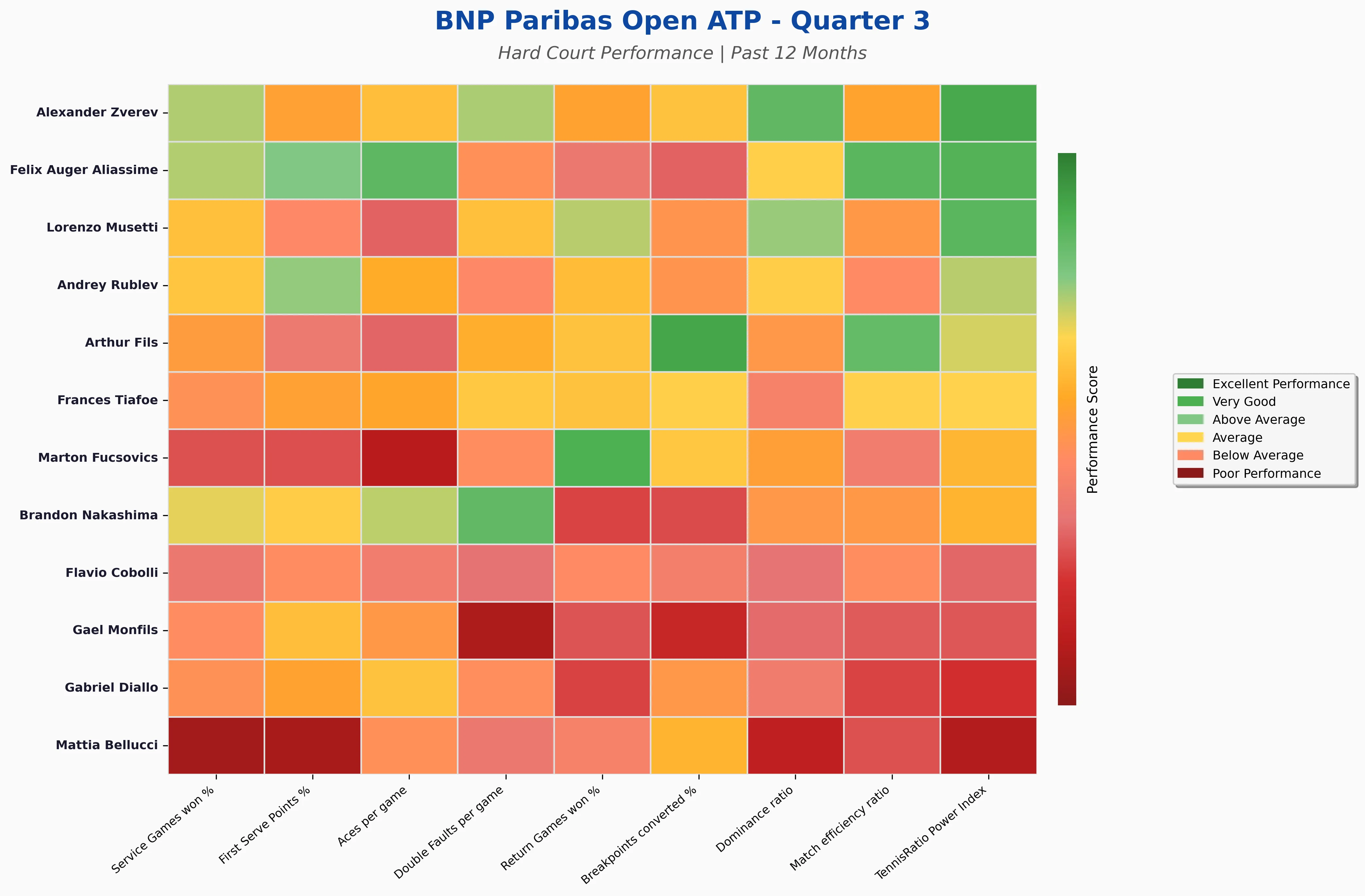
Third quarter seems to be super competitive without any specificly strong favorite as all the other sections. Alexander Zverev is the top seed (4th) and leads the performance metrics, however his form after gruelling lose to Alcaraz in quarterfinals of Australian Open were not followed by any significant result yet - he played just in Acapulco last week, surprisingly losing to Miomir Kecmanovic in early phases. Felix Auger Aliassime comes there with resurgence after facing physical problems at AO - the Canadian was the winner of ATP 250 in Montpellier, finalist in Rotterdam and made another deep run in Dubai, losing to eventual champ Medvedev in semifinals. Fifth seed Lorenzo Musetti brings momentum from his Australian Open run, where impressive wins over Taylor Fritz and Tomas Machac demonstrated his growing hard court comfort.
Fifteenth seed Flavio Cobolli arrives there after a breakthrough on hard courts - the surface he always struggled very much in compare to favorite clay. The Italian is a new world number 15 after winning his maiden ATP title on hard in Acapulco.
Alexander Zverev leads this section in controlling matches and minimizing errors, while Felix Auger Aliassime and Lorenzo Musetti show strong statistical profiles across multiple metrics. Andrey Rublev, Arthur Flis or the finalist from Acapulco - Frances Tiafoe are also the players who can surely put some momentum, so this section will be super exciting to follow with anyone able to get into semifinals from there.
Quarter 4: Sinner anchors bottom section
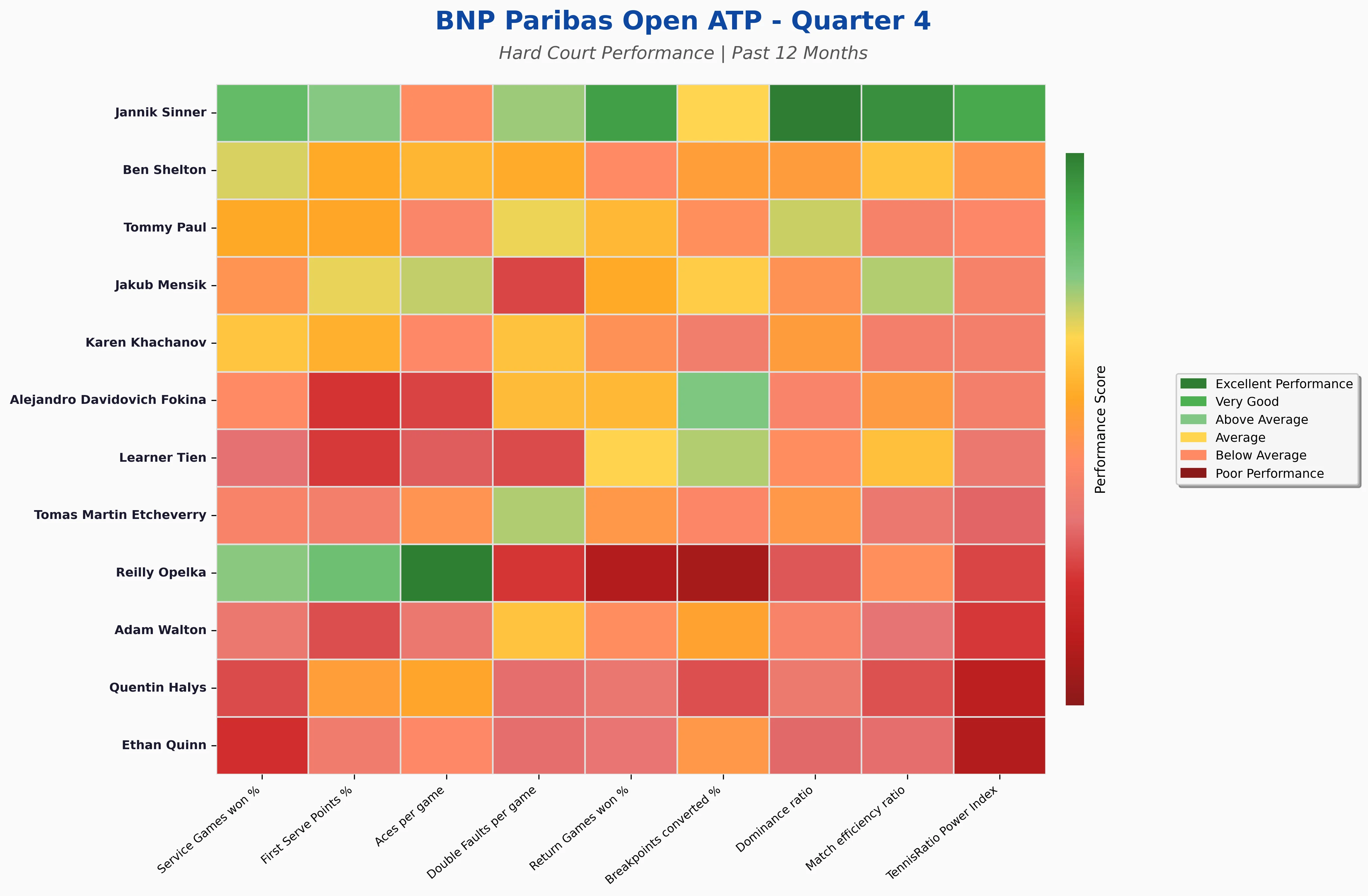
Second seed Jannik Sinner comes to California after recent Doha stumble, where Mensik's aggressive approach troubled the typically composed Italian. Sinner's 88.6% hard court win rate remains elite, supported by 80.2% first serve points won and an impressive 90% tiebreak record. Eighth seed Ben Shelton arrives with excellent momentum after winning title in Dallas, that included thrilling victories over Denis Shapovalov and Taylor Fritz.
Twelfth seed Jakub Mensik emerges as a genuine dark horse following his stunning victory over Sinner. The young Czech's 73.1% tiebreak record and 13.1 aces per match suggest he thrives under pressure, while his aggressive style could trouble higher-seeded opponents. That was already displayed in Doha, where the Czech has surprisingly defeated Jannik Sinner. The points will be crucial for Mensik who defends all the tally from sensational last year's victory in Miami later on this month.
Jannik Sinner demonstrates exceptional match control and efficiency in converting opportunities, while Ben Shelton and Tommy Paul show strong serving and strategic execution. The Italian is the obvious favorite to go into final from whole the bottom half, however his 2026 appearances did not materialize the role of favorite, facing the surprising defeats from Djokovic and Mensik in AO and Doha.