The 2026 French Open gets underway on Sunday with a notable absence hanging over the draw - defending champion Carlos Alcaraz will not be in Paris after a wrist injury forced him out of the clay swing and is set to sideline him through the grass court season as well. That leaves Jannik Sinner as the overwhelming favorite, his remarkable clay court form over the past 12 months making a powerful case for a maiden Roland Garros title. The world No. 1 sits in the top half opposite a wide-open second quarter where both Felix Auger-Aliassime and Daniil Medvedev have struggled on the surface this season. The bottom half promises fireworks with Novak Djokovic returning from a shoulder injury that limited him to just one clay court match in 2026, yet the 23-time Grand Slam champion still looms as the most dangerous floater in the draw. Alexander Zverev anchors the fourth quarter after a trophyless clay swing, while 19-year-old Rafael Jodar - a maiden titlist in Marrakech with back-to-back Masters quarterfinals in Madrid and Rome - emerges as the most exciting young contender in the field. With Casper Ruud riding a clay court resurgence, Arthur Fils carrying home hopes after his Madrid final run, and some of 32 seeds facing immediate first-round tests. Here is the breakdown of every quarter with preview and analysis
Sinner tops the first quarter in title bid
Top seed Jannik Sinner begins his campaign against French wildcard Clement Tabur, a manageable opener for the world No. 1 who absolutely dominates clay courts competition with 23 wins in 24 matches played during ranking period - the only one happened in one of the most epic Grand Slam finals in the history against Carlos Alcaraz there in Paris last year. Luciano Darderi can be first challenging opponent in the Italians's part of the draw. The fellowcountry world number 14 is a semifinalist of ATP 1000 in Rome with three another titles earned last year on that surface - Umag and Bastad in 2025 and in Santiago two months ago.
Sinner's path potentially leads to Ben Shelton in the quarterfinals, where their contrasting styles would create fascinating theater. Sinner leads their head-to-head 9-1, including a straight-sets victory at this year's Australian Open. Shelton has started his European clay season very well with ATP 500 title won in Munich, but faced three early exits in Madrid, Rome and Hamburg.
Alexander Bublik is opening against Jan Lennard Struff with his explosive serve averaging 7.7 aces per match on clay. The German is also not shy there with 6 aces per match, which forecasts some sort of serve-bombing fest. The ninth seed's unpredictable shot-making could trouble any opponent, though consistency remains his biggest challenge. Bublik can set up interesting clash against Frances Tiafoe in round of 16 - the American was a quarterfinalist there last year and made into semis in Houston recently in April.
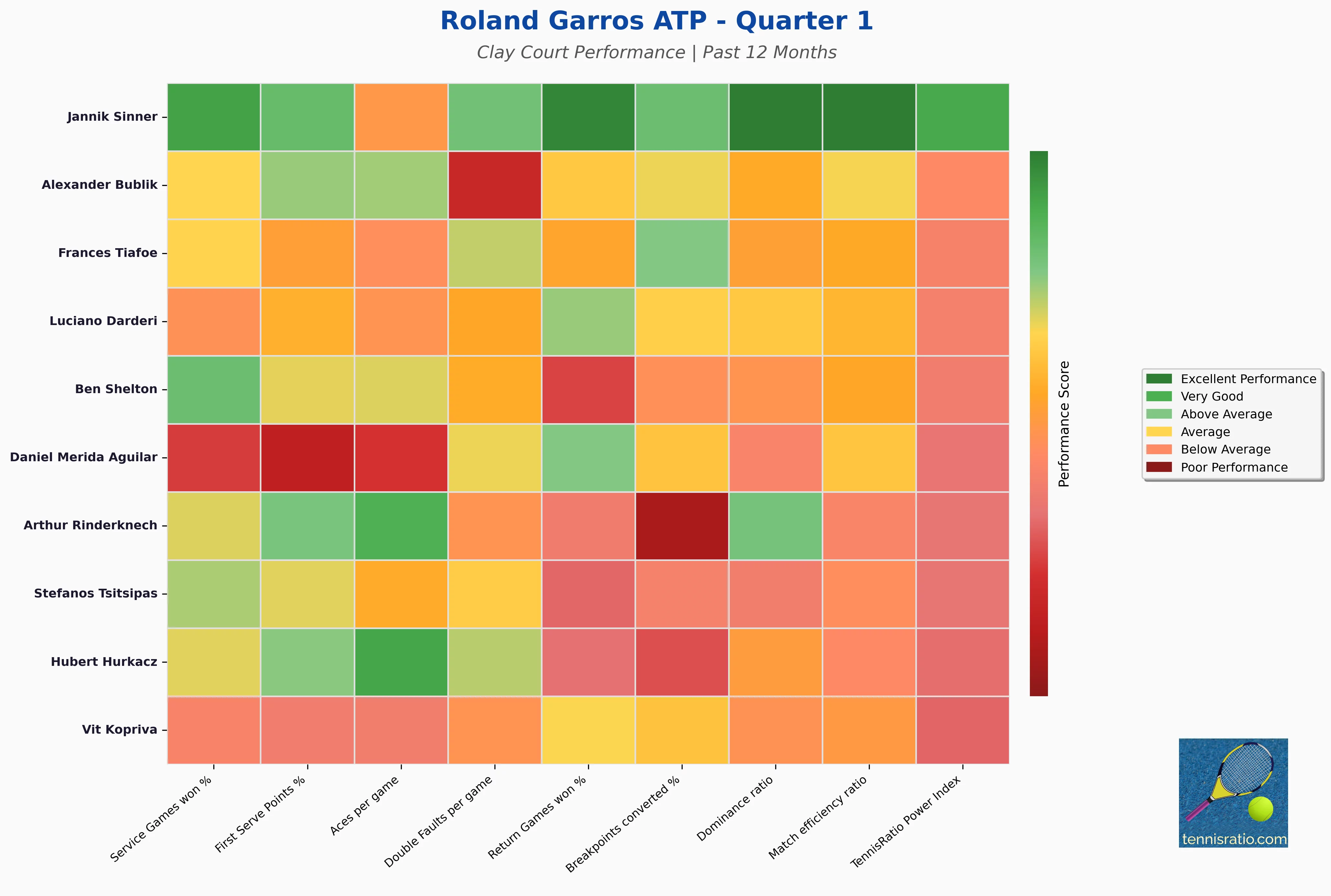
The statistical landscape in this section reveals Jannik Sinner's dominance in match efficiency and controlling rallies, while Alexander Bublik excels with first serve effectiveness and raw power. Frances Tiafoe shows strong clutch performance on break points, making him a dangerous challenger on a good day despite inconsistent clay results.
Opened wide second quarter with struggling top seeds
Fourth seed Felix Auger Aliassime meets Daniel Altmaier in his opener, facing a player who took a set from Taylor Fritz at last year's tournament and performed an upset over Ben Shelton in second round of ATP 500 in Hamburg this week.The Canadian's clay struggles continue with just a 53.8% win rate on the surface in last 52 weeks, though his powerful serve generates 5.8 aces per match. A potential quarterfinal against Daniil Medvedev looms, where Medvedev leads their head-to-head 7-2 despite his own clay court limitations.
The Russian opens against French wildcard Adam Walton, seeking to improve on his modest 55.6% clay win rate. His return pressure of 36.2% against first serves shows promise, but second serve vulnerability at 43.5% points won could prove costly. Flavio Cobolli faces a qualifier in round one, the Italian riding strong clay form with 16 wins from 22 matches and solid baseline consistency. The Italian was a finalist in Munich, but his further outings were quite disappointing. Cobolli was a quarterfinalist in Rome, but his title defense in Hamburg ended on first match, getting defeated by qualifier Ignacio Buse. Despite this, clay court credentials of Cobolli make him the best performing contender in second quarter, taking all the struggles of top seeds into consideration.
This quarter showcases Flavio Cobolli's efficiency in converting opportunities and strong service games, while Francisco Cerundolo - the ATP 250 Buenos Aires champ, dominates return statistics and creates more break chances than he faces. Valentin Vacherot provides additional depth with excellent match efficiency including his run into semis in ATP 1000 on home soil in Monte Carlo despite limited clay exposure this season.
The projected top half semifinal between Sinner and Auger-Aliassime heavily favors the Italian, who won their most recent encounter at Monte Carlo in straight sets. Sinner's superior clay court record and current form make him the overwhelming favorite to reach another French Open final in top half.

Djokovic starts his quest in third section with dangerous contenders
Third seed Novak Djokovic faces Giovanni Mpetshi Perricard in a compelling first-round encounter, the towering Frenchman's serve potentially causing early problems for the veteran champion.
Djokovic has the record of 9-2 on clay in ranking period, however it's all build in Geneva run title and Roland Garros semifinals campaign last year. In 2026, the Serbian champ was recovering from a shoulder injury and played just one match on clay, losing to Dino Prizmic in the sole appearance in Rome. A projected quarterfinal against Alex De Minaur would favor the Serbian's experience and superior clay court pedigree though, as clay is far from being a favourite surface for the Australian who succeeds mostly on hard.
Alex De Minaur opens against a qualifier. The world number 9 has just 54.5% win rate on the surface. His 80% tiebreak success could prove vital in close matches, while consistent return pressure of 31.1% against first serves keeps him in rallies. De Minaur was a quarterfinalist in Monte Carlo and made into same stage (at least) in Hamburg, however his Rome and Madrid campaigns ended on first matches. Casper Ruud faces a qualifier in round one. The Madrid Open champion from 2025 lives a redemption on clay. He started the 2026 season with just half of 14 matches won on hard, but is 12-3 on red dirt, including a run to final in Rome and still being involved in ATP 250 in Geneva (advanced to semis on Thursday).
Eleventh seed Andrey Rublev sets up a most exciting first round clash in this quarter, playing against Ignacio Buse. The Peruvian player displays a great form on clay, winning 14 out of 23 matches this season. Buse has made (at least) into semifinals in ATP 500 Hamburg this week, which also guarantees the advance to top 50 for the 22 years-old. Rublev was a finalist in Barcelona and quarterfinalist in Rome, which does also give lots of hopes before Roland Garros for the former world number 5.
The data shows Novak Djokovic maintaining strong service games and controlling match dynamics, while Casper Ruud excels in return games and creating break opportunities. Tommy Paul brings excellent match efficiency and clutch break point conversion to complement this competitive section. The American can set up probably one of the most exciting match-ups of first week against Casper Ruud. Both can meet as early as in third round - the first between projected seeds. Paul won the ATP 500 in Houston in April and has a great record of 11-3 on clay in last 52 weeks.

Zverev and new rising stars feature last quarter
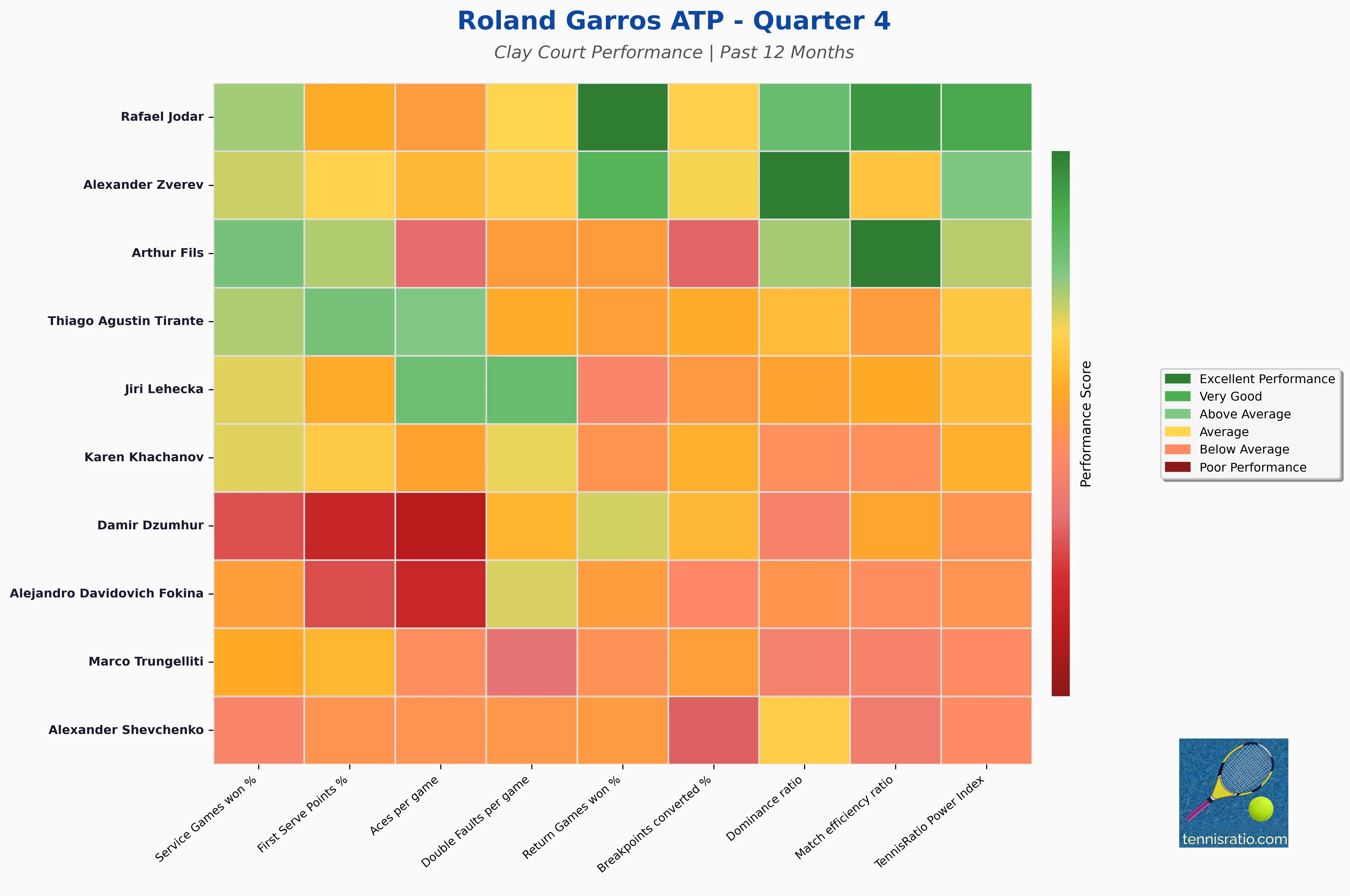
Second seed Alexander Zverev opens against Benjamin Bonzi, after a solid clay court preparations, which did not bring any trophy to collect though. Zverev advanced to final in Madrid, getting defeated by Zverev. Then, he got defeated by Darderi in Rome round of 16. Zverev felt the need to recharge his batteries, withdrawing from ATP 500 in Hamburg.
The German's projected path potentially leads to Taylor Fritz in the quarterfinals, though the American has played just one match on clay after long break since Miami, losing in first match of ATP 250 Geneva event. Fritz meets Nishesh Basavareddy in round one, the American desperately seeking clay court confidence after managing just one win in four matches in last 52 weeks. His powerful serve averages 9.8 aces per match, but return statistics of 18.8% against first serves highlight his struggles on the slower surface. Rising star Joao Fonseca faces a qualifier, the young Brazilian's aggressive style potentially causing upsets.
Arthur Fils won 9 out of 11 matches played on clay including the run to final in Madrid preceeded with ATP 500 title in Barcelona. The Frenchman is biggest hope of home fans, coming there after two weeks of break following precautionary withdrawal from second round of Rome due to back pain issues. Fils can set up an exciting round of 16 clash against Zverev, unless he navigates through previous rounds. Fils starts against Stan Wawrinka who makes a farewell appearance at Roland Garros. With 17th seed, the Frenchman possibly meets the top 16-ranked Karen Khachanov early in third round with even more difficult hardles in each another round.
Rafael Jodar brings very much of hype, being the most exciting newborn star of this season so far in ATP field. The 19 years-old won his maiden title in Marrakech in April, then following this with semis in Barcelona and back-to-back quarters in Madrid and Rome. Jodar is seeded with 27th with possible clashes to set up since third round. Taylor Fritz can be his opponent there and looking at the current trends, the American would barely be a favorite if this happens. Jiri Lehecka and Alejandro Davidovich Fokina are another contenders to possibly meet with Jodar in round of 16.
The young Spaniard leads the fourth quarter's performance heatmap with strong return game and match efficiency, while Alexander Zverev dominates in controlling rallies and return statistics. Arthur Fils contributes excellent service games and overall efficiency.
The projected bottom half semifinal between Zverev and Djokovic promises compelling drama, with their contrasting approaches and recent form creating uncertainty. Djokovic's limited schedule is not in Serbian's favour, but his winning experience in the high profile clashes against Zverev could be decisive. Djokovic leads the H2H by 9-3 on professional level, including their clash there in Roland Garros quarterfinals last year.