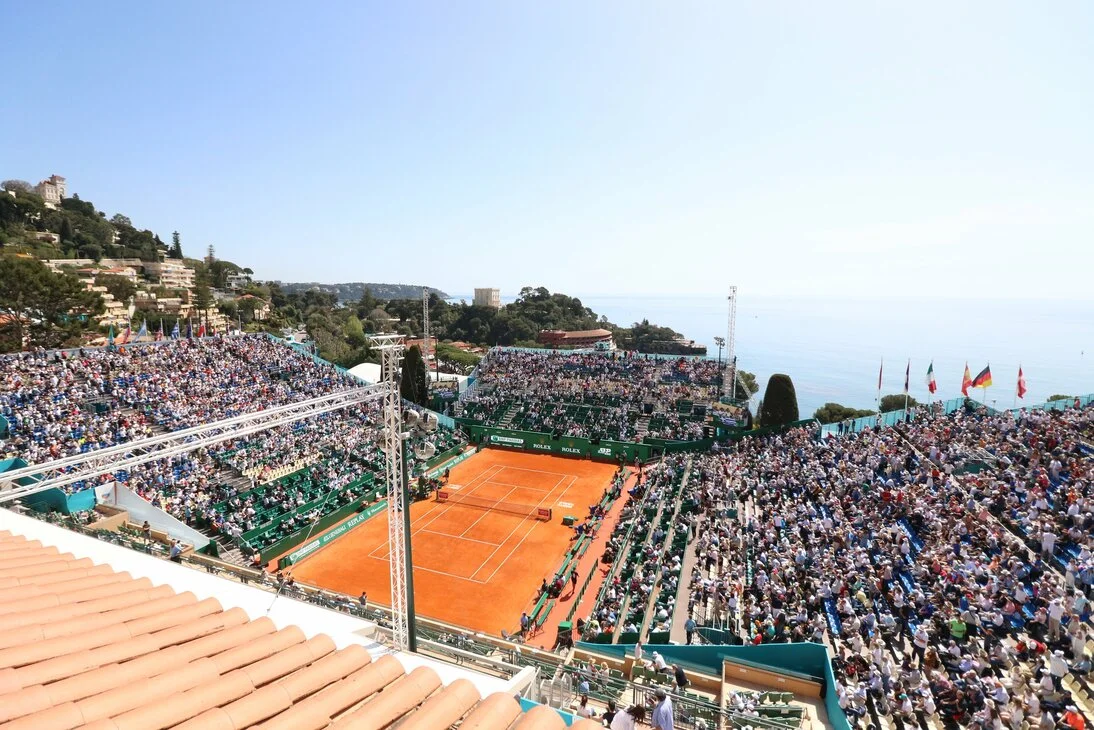
The European ATP season kicks-off with a style in the prestigious Monte Carlo Country Club from April 5-13, 2026, for the season's first ATP 1000 clay court event. The Rolex Monte Carlo Masters brings together an exceptional 56-player draw featuring seven of the world's top 10 players, setting the stage for compelling storylines on the Mediterranean clay courts.
World No. 1 Carlos Alcaraz arrives as the overwhelming favorite with a dominant 22-1 clay court record over the past 12 months, including his thrilling five-set victory over Jannik Sinner at Roland Garros. The Italian No. 2 seed brings his own momentum with a perfect 12-match winning streak from recent matches on hard, while his 11-2 clay court record from 2025 suggests he will take up the fight with Alcaraz on clay another year again. Alexander Zverev completes the triumvirate of favorites, seeking to overcome his 3-11 record against top 10 opponents in last 52 weeks with his powerful serve that generates 5.0 aces per match on clay.
Novak Djokovic withdrew a few days before the start of tournament. All the top ranked American players, Alejandro Davidovich Fokina, Jack Draper or Arthur Fils are the other missing players in this packed and high quality field.
Quarter 1: Alcaraz opens title defense
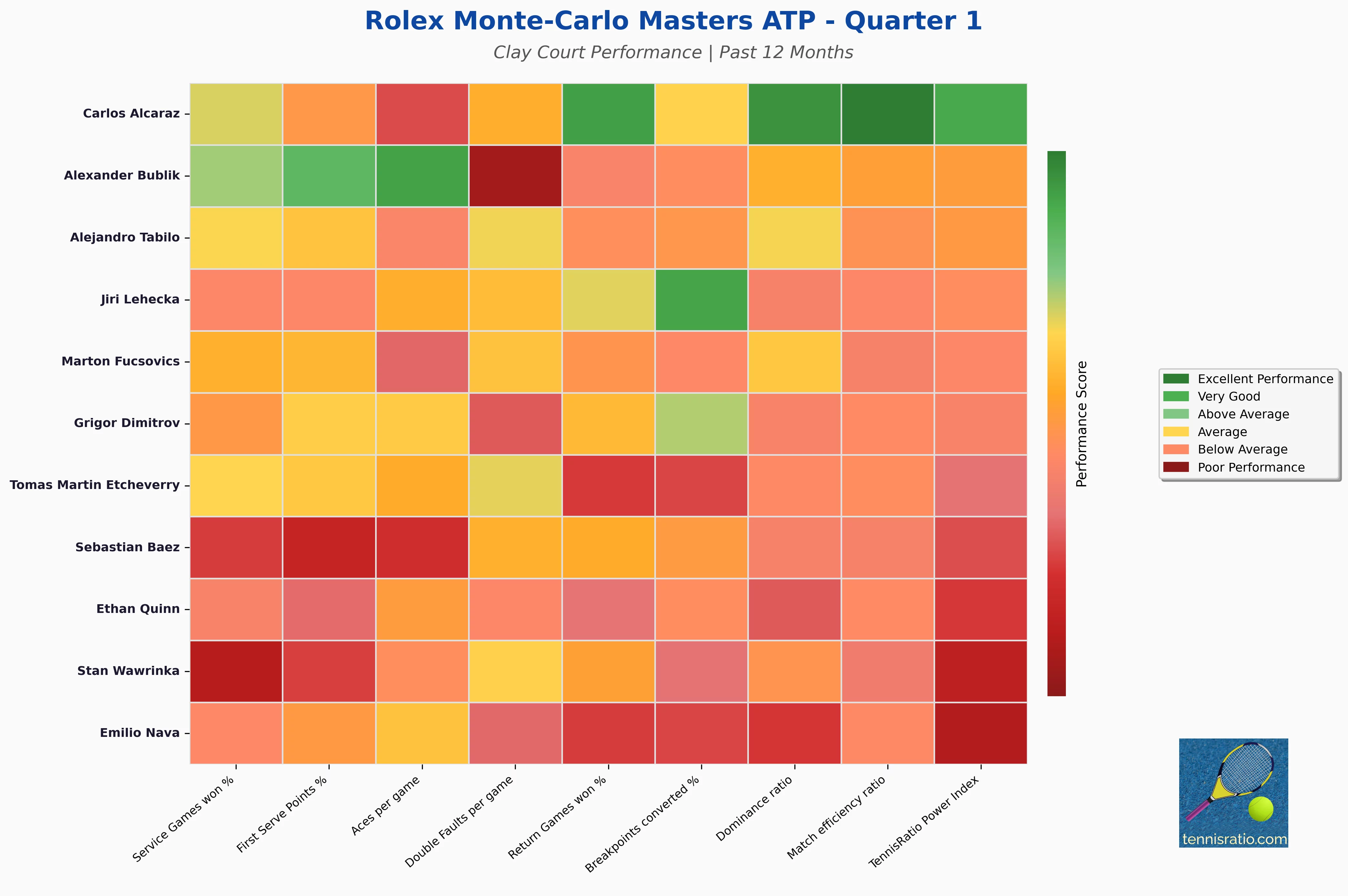
Carlos Alcaraz receives a first-round bye as all the top eight seeds and would face either qualifier Sebastian Baez or the wild card Stan Wawrinka in his opening match. The Swiss plays hist last season in professional career and the match-up with Alcaraz would be a great generational battle with heavily favorized world number one in this battle. First seeded opponent for Alcaraz can be 11th seed Jiri Lehecka. The Czech's 50% clay court record (5-5) contrasts sharply with his recent strong hard court form, having won seven of his last 10 matches across all surfaces. Their last encounter at the US Open showcased Alcaraz's dominance in straight sets, though Lehecka's improved return statistics (35.6% vs first serve, 48.3% vs second serve) on clay suggest he could pose more problems on the slower surface.
Eighth seed Alexander Bublik brings his unconventional game to clay with impressive statistics, leading the field with 9.7 aces per match and winning 76.8% of first serve points on the surface. The Kazakh sets up an exciting battle with Gael Monfils, who also retires after this season. The Frenchman has already defeated Tallon Griekspoor in first round on Sunday, proving the ability to compete on the highest level till the end days of his career.
Looking at the statistical landscape of this section, Carlos Alcaraz dominates the match efficiency and dominance ratio categories, reflecting his ability to convert strong baseline play into victories. Alexander Bublik excels in the power serving metrics with his exceptional ace production and first serve effectiveness. Alejandro Tabilo is a dark horse here with a good 12-6 record on clay in last 52 weeks on top level.
Quarter 2: Italians come back on their favorite surface
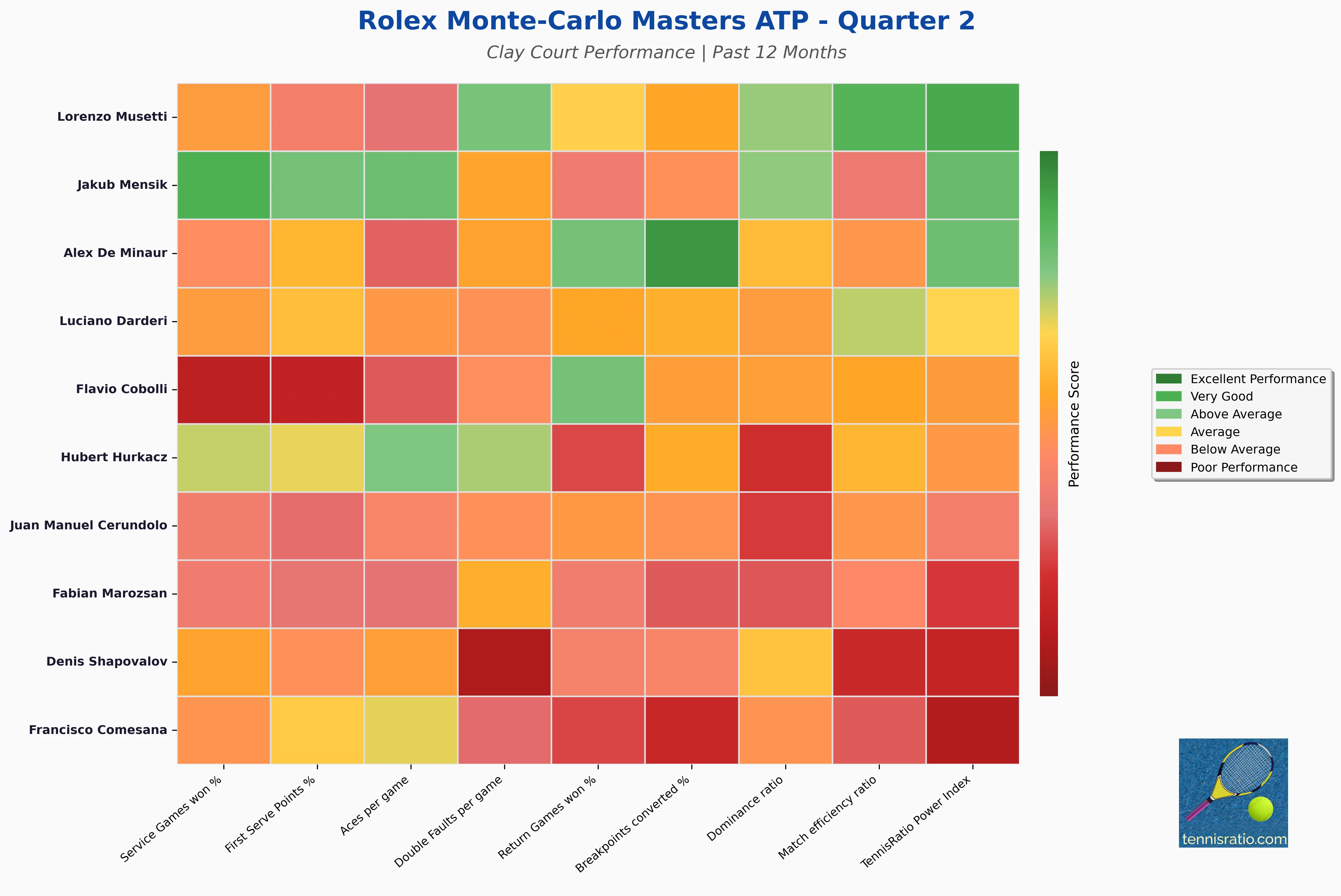
Fourth seed Lorenzo Musetti enters his section with hopes to shine on his favourite surface despite a recent three-match losing streak, boasting an impressive 18-4 clay court record that includes his semifinal run at Roland Garros. The Italian faces a potential second-round clash against local Valentin Vacherot or Juan Manuel Cerundolo.
This quarter is featured by the Italian clay court specialists who festived great 2025 season and managed to improve their hard court credentials over the recent months as well. Tenth seed Flavio Cobolli opens against qualifier Francisco Comesana, carrying solid clay form with a 14-5 record and strong return statistics (38.9% vs first serve). Cobolli was struggling on hard, but clinched the ATP 500 title in Mexico month ago, which is a sign of overall improvement.
15th seed Luciano Darderi faces struggling Hubert Hurkacz in first round. Darderi can meet Musetti as early as in round of 16 with Jakub Mensik hunting in second round as well. Darderi's exceptional 28-8 clay court record and 83.3% tiebreak success rate make him a dangerous opponent who could upset higher seeds.
The other star in this section is Alex De Minaur. Clay is not the favourite surface for the Aussie, although he carries a solid 10-5 record from 2025. He started this season very well with a victory in Rotterdam, although March campaign in USA was not successful for the world number 6 who looks for the improvement. He starts against Cameron Norrie in second round and can meet Cobolli in round of 16.
The statistical picture in this quarter reveals Lorenzo Musetti's excellent match efficiency ratio and double fault control, while Jakub Mensik impresses with strong service game statistics and ace production. Alex De Minaur stands out for his breakpoint conversion rate and return game prowess.
The projected top-half semifinal between Alcaraz and Musetti would renew their compelling rivalry, where the Spaniard leads 8-1 but has faced increasingly competitive matches from the improving Italian on clay courts.
Quarter 3: Zverev's clay court resurgence
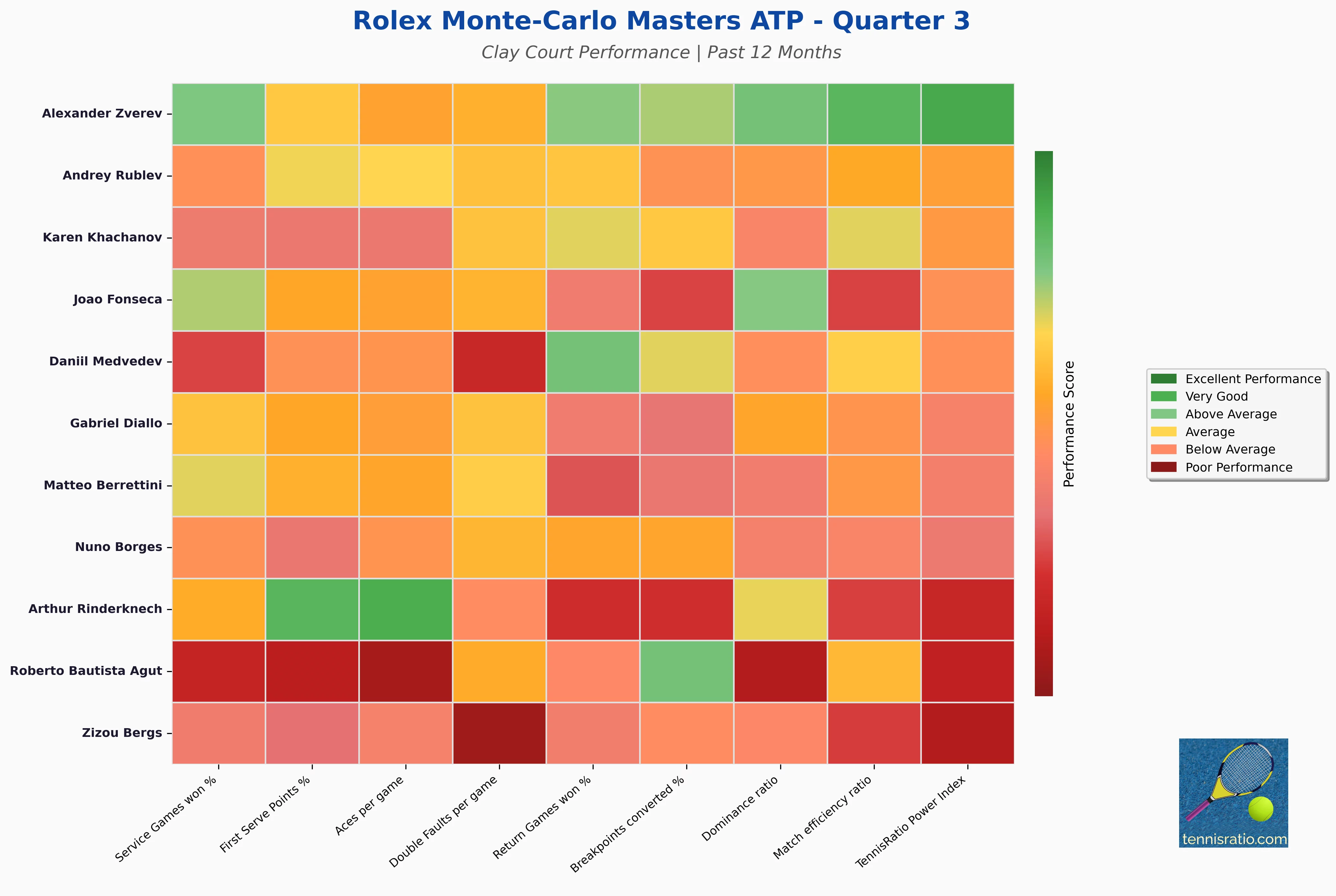
Third seed Alexander Zverev receives a bye and anchors a dangerous section that includes two in-form Russians. The German's 15-5 clay court record over the last year and 70% tiebreak success rate demonstrate his improved comfort on the surface, though his 3-11 record against top 10 opponents in last 52 weeks remains concerning. Seventh seed Daniil Medvedev also receives a bye but brings limited clay court sample from last season with just a 6-4 record, despite recent strong form winning eight of his last 10 matches.
The section features an intriguing first-round clash between Arthur Rinderknech and 12th seed Karen Khachanov, who holds a 60% clay court record and solid return statistics. Thirteenth seed Andrey Rublev faces Nuno Borges in round one, carrying his traditional clay court inconsistencies with a 57.1% win rate despite powerful serving (6.1 aces per match). The all-Russian clash between Medvedev and Khachanov can happen in round of 16 due to seedings, while Zverev can set up an intriguing battle with Rublev on the same stage.
Alexander Zverev leads this section's statistical profile with excellent match efficiency and dominance ratios, while Andrey Rublev excels in first serve effectiveness and ace production. Karen Khachanov shows strong return game statistics and match efficiency.
Quarter 4: Sinner's clay court test
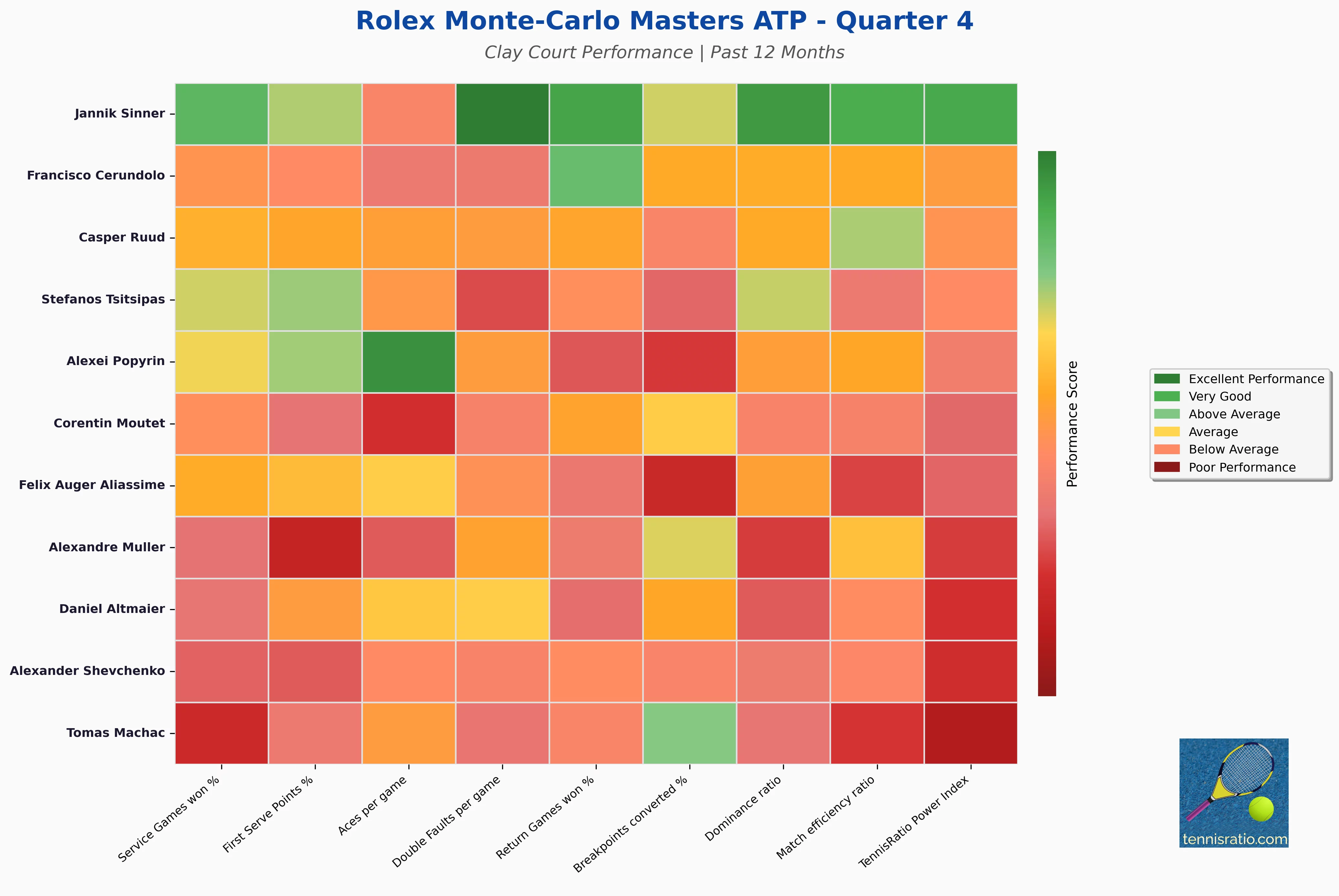
Second seed Jannik Sinner looks forward to a solid start of 2026 season, playing on clay for the first time since the defeat in epic final of Roland Garros against Alcaraz last year. His 11-2 clay court record in 2025 includes quality wins, though his 50% tiebreak success rate on the surface suggests room for improvement in crucial moments. Sinner will start against one of French players - either Ugo Humbert or the 17 years-old youngster Moise Kouame who received wild card to main draw.
Sixth seed Felix Auger Aliassime also receives a bye but carries concerning clay court results from last year. The Canadian was a semifinalist in Hamburg, but apart from this noted four first round exits in Monte Carlo, Munich, Madrid and Roland Garros.
Ninth seed Casper Ruud opens against Alexei Popyrin, bringing his natural clay court pedigree with a 73.7% win rate despite recent inconsistent form. Sixteenth seed Francisco Cerundolo represents the dangerous South American clay court specialist with a solid 66.7% record and strong return statistics (36.0% vs first serve, 54.8% vs second serve). Cerundolo kick-off against past Monte Carlo champion - Stefanos Tsitsipas. The Greek looks for the bounce back of the sliding trajectory in his career - he is ranked 49th in ATP list right now.
The statistical breakdown reveals Jannik Sinner's huge advantage against all the opponents in this section. It's difficult to predict his most challenging opponent there considering the struggles of highest seeded Felix Auger Aliassime on clay last year. Francisco Cerundolo excels in return game categories. Casper Ruud shows strong match efficiency despite recent struggles from last year. The class and experience of Stefanos Tsitsipas who feels very well on Monte Carlo soil is also not to underestimate.