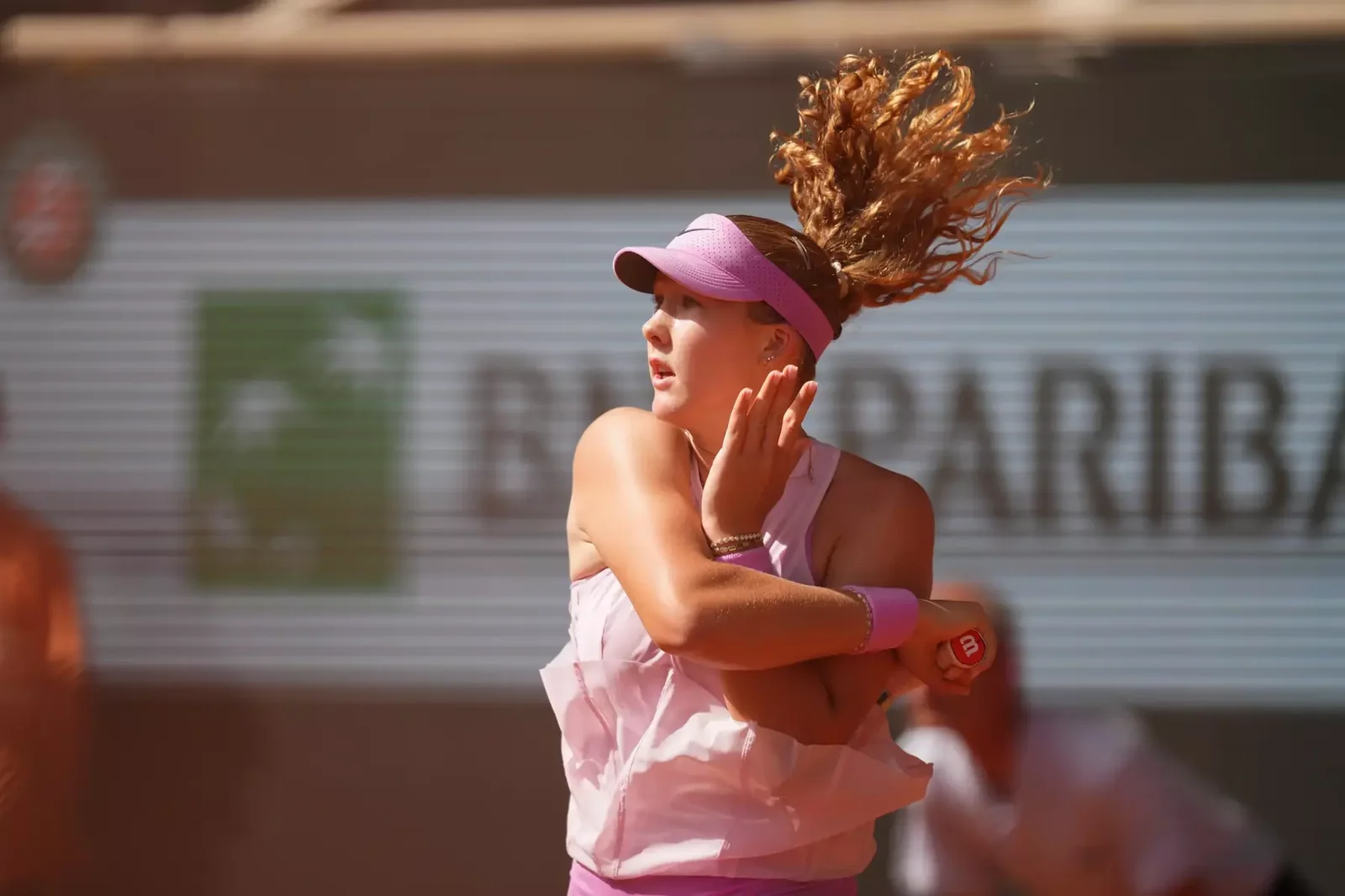
Friday's third round at Roland Garros places eight women's singles matches across the schedule that will begin to determine who belongs in the conversation for the title. Mirra Andreeva steps onto court as the quarter's new favourite following Elena Rybakina's second-round exit, while Iga Swiatek faces compatriot Magda Linette in the day's most emotionally charged contest - a rematch of a Miami encounter Linette won convincingly just two months ago. Marta Kostyuk carries a 13-match winning streak into a potentially tricky assignment against a Viktorija Golubic side that has looked dominant on the surface this week. Elina Svitolina meets the tournament's surprise package in Tamara Korpatsch, and Sorana Cirstea - in what she has declared her farewell season - sees the clearest path to a quarterfinal she has had in 17 years.
Andreeva as title contender, Bouzkova seeks third-round breakthrough
Mirra Andreeva enters Friday as the clear favourite in her quarter and one of the tournament's most credible title contenders after second seed Rybakina's second-round exit removed the most dangerous threat in that section of the draw. The 19-year-old Russian owns the best clay-court record on the WTA Tour this season at 17-3, a figure built on front-foot aggression and an ability to grind opponents into errors from both wings. Wednesday's opening set against qualifier Marina Bassols Ribera - a set she dropped before winning the match 3-6, 6-1, 6-1 - was a brief wobble rather than a warning sign. Once Andreeva found her range, she reeled off 12 of the final 14 games without complication.
Marie Bouzkova has reached the third round at Roland Garros for the third consecutive year and has never found a way past it. The 28-year-old Czech arrives with genuine credentials - a WTA 250 title in Bogota on clay this season and straight-set wins over Lucia Bronzetti and Francesca Jones in the first two rounds - though neither of those opponents came close to testing her at the level Andreeva will. The step from beating players outside the top 100 to facing a Grand Slam contender on Philippe-Chatrier is a significant one, and Bouzkova's inability to convert this stage in previous years points to a pattern she will need to break emphatically to advance. Should Andreeva win, Sorana Cirstea - with her 12-3 clay-court record - represents the most dangerous opponent remaining in her quarter.
Swiatek and Linette bring Miami rivalry to Roland Garros clay
Few third-round matches at this tournament carry the weight of an all-Polish encounter between a four-time champion and a compatriot who beat her convincingly just two months ago. Magda Linette's 1-6, 7-5, 6-3 victory over Swiatek in Miami in March - overcoming a difficult opening set before taking the final two with controlled, consistent tennis - was no fluke. The 34-year-old, coached by former world No. 2 Agnieszka Radwanska, has combined tactical clarity with remarkable mental fortitude this season, winning 12 of 18 serve pressure points against Jelena Ostapenko on Wednesday and carrying an 11-2 record in three-set matches in 2026. Her ability to stay composed under pressure is at a career high.
Swiatek's day against Sara Bejlek on Wednesday was far from clean - just 37% first serve landed in the opening set, 17 winners against 38 unforced errors across a match that took 17 games - but the four-time champion found ways to win regardless. The broader picture remains firmly in her favour: her draw has opened considerably with both Rybakina and Ostapenko eliminated from the same section, and a knee concern that shadowed Linette throughout her first-round win adds a physical variable the veteran can ill afford to manage deep into a match. Still, Miami proved Swiatek can be beaten when opponents keep the ball in play and force errors, and Linette has the tactical intelligence and recent precedent to attempt exactly that on clay.
Kostyuk's winning streak meets its sternest test against resurgent Golubic
Marta Kostyuk extended her unbeaten clay-court run to 13 matches on Wednesday, grinding past Katie Volynets 6-7(4), 6-3, 6-3 in a match that required more fight than the Madrid champion might have expected. It was her first third-round appearance at Roland Garros since 2021, and her 13-0 record on the surface this season - built on return dominance, winning 20 of 50 return pressure points against Volynets alone - underlines how completely her clay-court game has matured.
Viktorija Golubic is ranked 82nd but has looked a different level this fortnight. Defeats of Panna Udvardy 6-0, 6-2 and Alicia Parks 6-2, 6-2 in the opening two rounds - the sheer authority of those scorelines notable against players ranked 59th and 79th respectively - suggest a Swiss player moving freely and finding the surface to her liking. Kostyuk leads their head-to-head 2-0, though their last meeting came back in 2022, and Golubic now represents a more rounded clay-court operator than that record might imply. Should both Kostyuk and Swiatek win their respective matches Friday, the fourth round on Sunday would produce what may be the most compelling match of the second week - an all-Polish-Ukrainian encounter between the tournament's two most in-form players.
Svitolina faces career-best Korpatsch before her draw tightens
Elina Svitolina's Roland Garros campaign has carried a theme of difficult openings giving way to composed recoveries. Monday's three-set escape against Anna Bondar - where the Rome champion was broken serving for the match before holding her nerve in the tiebreak - gave way to a far more controlled 6-0, 6-4 win over qualifier Kaitlin Quevedo on Wednesday, which preserved energy and extended her winning streak to eight matches. The seventh seed's 29-7 season record and Rome title, which included consecutive wins over the world No. 2, 3 and 4, make her the clear favourite here.
Tamara Korpatsch has made the third round of a Grand Slam for the first time in her career and has done it with conviction. The 31-year-old German, ranked 95th, defeated 32nd seed Xinyu Wang in a match remembered as much for its off-court drama - a line-call dispute that ended with Wang refusing to shake hands at the net - as for the tennis itself. Converting five of eight break points and winning 25 of 44 serve pressure points, Korpatsch showed the defensive resilience and footwork that have made her a reliable clay-court operator at the Challenger level and, increasingly, beyond it. Her first serve averaged just over 120 km/h on Wednesday, which Svitolina's aggressive return game will target. This is their first meeting. A win here narrows the path for Svitolina considerably - a potential fourth-round encounter with Belinda Bencic and a possible quarterfinal against Swiatek or Kostyuk represent the challenges that await.
Cirstea hunts first Roland Garros quarterfinal in 17 years against Sierra
When Sorana Cirstea last reached a Roland Garros quarterfinal, she was 19 years old and the tournament was won by Svetlana Kuznetsova. Seventeen years on, in what she has announced as her farewell season, the 36-year-old Romanian has the clearest route to repeating that result that she has seen in nearly two decades. Rybakina's second-round exit and Jasmine Paolini's third-round loss before they even reached Cirstea have cleared much of the opposition, and her 12-3 clay-court record in 2026 - headlined by a Rome semifinal where she eliminated Aryna Sabalenka - makes this a legitimate pursuit rather than a career-end footnote.
Solana Sierra has established herself as one of the tournament's most compelling stories this fortnight. The 21-year-old Argentine dismissed Emma Raducanu in the first round before recovering from a difficult opening set to eliminate 13th seed Paolini 3-6, 6-4, 6-3 in the second - though Paolini's foot injury visibly affected her movement in the closing stages. A fourth-round appearance at Wimbledon last year showed Sierra can navigate deep into Grand Slam draws, and she brings momentum and confidence into a match where she will be the underdog. For Cirstea, this is the match that opens the door to the quarterfinal that has eluded her for the better part of two decades.
Bencic eyes first fourth round as Stearns brings signs of recovery
Belinda Bencic has yet to be seriously tested in Paris. A 6-2, 6-3 first-round win over qualifier Sinja Kraus was followed by an even more dominant 6-4, 6-0 dismissal of Caty McNally on Wednesday - dropping just six points in an almost flawless second set. The 11th seed is chasing her first fourth round at Roland Garros, a target that has eluded her throughout her career despite her pedigree on the surface, and the draw continues to offer a credible route.
Peyton Stearns sits at 78th in the rankings partly because she failed to defend points from a Rome semifinal last year, a slide that understates the form she has produced at this tournament. The American won her first two matches without dropping a set, including an opening win over Sofia Kenin, and arrives with the confidence of someone who has performed when it has mattered. Whether that level is sufficient against Bencic at this stage of a Grand Slam is the central question, but Stearns is not simply filling a bracket.
Muchova meets returning Teichmann in clash of resilience and experience
Karolina Muchova has looked every bit the 2023 finalist this fortnight. A 6-2, 6-2 win over Kamilla Rakhimova in the second round continued a run in which the 10th seed has yet to drop a set, and her comfort at this stage of Roland Garros - built through years of physical setbacks and the experience of reaching the final three years ago - gives her a composure that few players can replicate in Paris.
Jil Teichmann's presence in the third round is a story in itself. The Swiss player returned from seven months away from competition and made her run matter, defeating Magdalena Frech 7-5, 6-4 in the second round in a result that spoke to both her returning form and her resilience after a long absence. Ranked 170th, Teichmann faces a considerable step up against Muchova, but her disruptive clay-court game and the freedom of someone with nothing to lose make her an opponent who cannot simply be dismissed.
Starodubtseva carries Rybakina momentum into Wang clash
Yuliia Starodubtseva walks into Friday's match with the tournament's most significant upset behind her. Her 3-6, 6-1, 7-6(4) defeat of second seed Rybakina on Wednesday - her first career win over a top-10 opponent after six previous failed attempts - was not built on good fortune. After dropping the opening set, Starodubtseva dominated the second with aggressive returning before winning 13 of 24 serve pressure points in the decisive moments of a tense tiebreak. The Charleston finalist has shown across this season that she performs when the occasion demands it.
Xiyu Wang, ranked 148th, advances after Hailey Baptiste's devastating knee injury forced a retirement when Wang led 5-4 in the first set on Wednesday - a result that carries as much heartbreak for the American as it does fortune for the Chinese player. Wang has limited tour-level experience at this stage of a Grand Slam, and Starodubtseva - who has spent years building exactly the clay-court game that has carried her this deep in Paris - will be determined to extend a run that now carries genuine significance.


