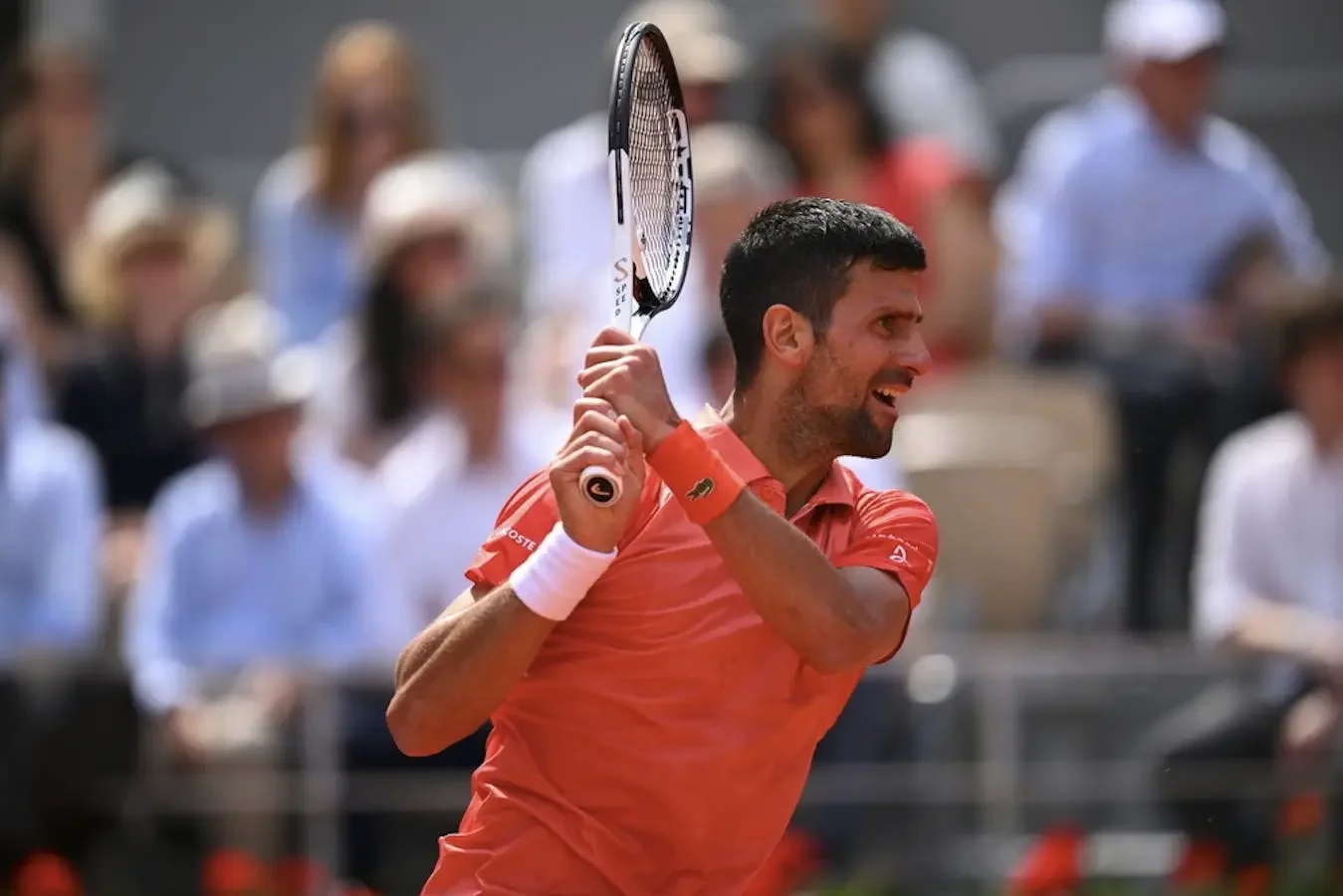
Djokovic meets Fonseca in generational blockbuster
The most anticipated match of the third round pairs the 24-time Grand Slam champion against the player who may define the next era of men's tennis. Novak Djokovic has navigated his first two rounds with increasing authority after arriving in Paris with serious question marks - his only clay court match before the tournament was a loss to Dino Prizmic in Rome following a two-month shoulder injury layoff. Against Mpetshi Perricard, he dropped the opening set before finding his range and finishing with 45 winners to 18 unforced errors. Against Royer, a brief third-set wobble aside, he was largely in control across four sets. The rust is coming off, but the question remains whether he has had enough match time to sustain his level against elite opposition over five sets.
João Fonseca arrives with a very different energy. The 28th seed produced one of the performances of the tournament so far, coming back from two sets down against Dino Prizmic in a match that swung dramatically once the Brazilian found his rhythm in the third set. From 3-6, 4-6 down, Fonseca reeled off three consecutive sets - 6-3, 6-1, 6-2 - in a display of mental resilience that underlined why he is considered the real deal at just 20 years old. A Monte Carlo quarterfinalist this spring and ranked 30th in the world, the first Brazilian man seeded at Roland Garros since Thomaz Bellucci in 2011 has already shown he can handle the Paris stage.
This is their first career meeting, and there is a fascinating tactical dimension to it. Djokovic's return game and ability to extend rallies should test whether Fonseca can sustain offensive pressure over a longer format, while the Brazilian's aggressive ball-striking could expose any lingering rust in the Serbian's movement. Djokovic has reached at least the semifinals in each of his last two Roland Garros appearances, but Fonseca represents a different kind of threat - a player with nothing to lose and a game built to hurt.
Ruud and Paul promise high-quality clay court chess
This is arguably the most evenly matched contest of the round, bringing together two players in strong form with contrasting but complementary clay court profiles. Casper Ruud's tournament has already been an emotional rollercoaster - the two-time Roland Garros finalist survived an extraordinary first-round ordeal against Roman Safiullin, suffering a heat-related collapse and squandering five match points before somehow finding a way through in five sets. He recovered to beat Hamad Medjedovic more comfortably in the second round, reasserting his baseline authority and saving all seven break points faced.
Tommy Paul has looked sharp from the start. After dropping the opening set against Rinky Hijikata, the American responded with clinical tennis across the next three sets, firing 13 aces. He followed that with a cruise control win over Lorenzo Sonego - 6-3, 6-2, 6-4 - suggesting he is hitting his stride at the right moment. Paul's clay credentials are well established: he won the ATP 500 Houston title in April and reached the Hamburg 500 final, compiling a 14-4 clay record over the past 52 weeks. He was a quarterfinalist here last year, so the stage is familiar.
Ruud leads the head-to-head 3-2, though their last meeting was at Indian Wells in 2024, a different surface entirely. The Norwegian's 17-6 clay record over the last year underlines his pedigree, but the physical toll of that brutal first-round match could linger. Paul's serve - 13 aces in his opener - gives him a weapon that Ruud must neutralize early if he is to control the baseline exchanges that will define this match.
Halys brings tiebreak mastery into Zverev showdown
Quentin Halys has already matched his best Roland Garros result from last year, and he has done it in style. The Frenchman has been lethal in pressure moments, winning all three tiebreaks across his first two rounds while dispatching Mattia Bellucci and Ugo Humbert - the latter a significant scalp on home soil. His serving has been a weapon throughout, striking 11 aces against the Italian and 16 against Humbert, suggesting he arrives in the third round with genuine confidence and a game plan built around his delivery.
Their only previous meeting came in Miami in March, where Zverev edged through 7-6(4), 7-6(1) - a match decided entirely on serve. Friday's encounter could follow a similar script. Zverev has been clinical so far in Paris, dismissing Bonzi in straight sets and cruising past Machac in under two hours without allowing either opponent to establish any foothold. The second seed has reached at least the quarterfinals in each of the past five editions and continues to project as one of the strongest contenders in the draw.
The question is whether Halys can reproduce his tiebreak composure against a player of Zverev's caliber, particularly in front of a French crowd that will be firmly behind him. Zverev's serve and return depth should ultimately prove too consistent over best-of-five, but if Halys can drag sets into tiebreaks as he has done throughout, this could develop into a longer afternoon than the German would prefer.
De Minaur holds all the cards against Mensik
The eighth seed arrives in the third round with a significant advantage in freshness after receiving a walkover when Alexander Blockx withdrew with a sprained ankle ahead of their second-round clash. It was a frustrating outcome for the Belgian, who had been one of the breakout stories of the clay swing, but for De Minaur it means minimal physical expenditure ahead of what should be a demanding week. His only on-court work so far was a routine straight-sets dismissal of qualifier Toby Samuel, revealing little about his current level but preserving energy that could prove decisive.
Jakub Mensik arrives from the opposite end of the physical spectrum. The 27th seed needed 4 hours and 42 minutes to outlast Mariano Navone in a gruelling five-set battle that featured visible physical struggles on both sides, with Navone requiring a medical timeout as the heat took its toll. It was a gutsy performance from the 20-year-old Czech, who relied on his serve to escape pressure in the closing stages, but the recovery window heading into Friday is tight.
De Minaur leads the head-to-head 4-0, a commanding margin that adds another layer of difficulty for Mensik. The Czech has shown he can produce upsets on the biggest stages - he won the Miami Masters last year with a final victory over Djokovic - and his Grand Slam record of 16-8 reflects genuine competence at this level. But he has never advanced past the third round at a major, and overcoming both a 4-0 deficit in the rivalry and the physical hangover from Wednesday's marathon would require something exceptional.
Jodar and Michelsen battle for NextGen bragging rights
Rafael Jodar's Roland Garros debut has been everything the hype suggested and more. The 19-year-old Spaniard, the breakout star of the 2026 clay swing, powered past James Duckworth in four sets after a dominant opening set gave way to a much more physical contest. Jodar had to fight back from an early break down in the third and manage a tight fourth set to close it out - the kind of experience that builds resilience in a young player learning the demands of best-of-five tennis. His maiden title in Marrakech, followed by a semifinal in Barcelona and back-to-back quarterfinals in Madrid and Rome, has already established him as a legitimate force on clay at just 19.
Alex Michelsen, two years older at 21, has quietly achieved the best Grand Slam result of his career by reaching the third round for the first time. The American has taken care of business against lower-ranked opponents in the first two rounds, making the most of his seeding and draw position. However, his clay court credentials remain a question mark - he has never won more than two matches in a single ATP Tour event on the surface.
This is a NextGen clash with genuine stakes. Jodar's aggressive baseline game and clay court instincts should give him the edge, particularly in extended rallies where his ability to generate heavy spin and move the ball around the court has troubled more experienced opponents throughout the spring. Michelsen's cleaner ball-striking could cause problems if he can keep rallies shorter, but over five sets on clay, Jodar's comfort on the surface and recent momentum make him the clear favorite.
Rublev's dominance over Borges faces fresh test
Andrey Rublev has built a commanding 4-0 head-to-head lead over Nuno Borges, including a 6-4, 1-6, 6-1 win on clay in Monte Carlo just a month ago - a match that illustrated the pattern of their rivalry, with Rublev's power ultimately overpowering the Portuguese whenever the level fluctuates. The 11th seed's path through the draw has been solid if unspectacular: a four-set win over Ignacio Buse, one of the quiet hits of the first round, followed by a 6-1, 1-6, 6-3, 7-6(5) victory over Camilo Ugo Carabelli. The scorelines suggest a player capable of dominant stretches but still prone to concentration lapses.
Borges has advanced somewhat under the radar, starting with a valuable three-set win over 25th seed Tomas Martin Etcheverry - no easy task against a proven clay courter - and then coming through in four sets against Miomir Kecmanovic after dropping the opener. His Grand Slam record of 19-16 means he is approaching his 20th career main draw victory, and his second consecutive third-round appearance in Paris shows growing comfort at the highest level. At 51st in the rankings, the Portuguese brings steady baseline play and competitive toughness that could push Rublev if the Russian's focus wavers.
The 4-0 head-to-head is a significant psychological barrier, but Borges will take encouragement from the middle set in Monte Carlo where he dismantled Rublev 6-1, proving he has the tools to hurt him in stretches. The question is whether he can sustain that level long enough to change the outcome.
Khachanov's power meets De Jong's surprise run
Karen Khachanov has been one of the steadier performers in the draw, following his straight-sets dismissal of Arthur Gea with solid wins through the first two rounds and arriving with the confidence of a Rome quarterfinalist. The 15th seed's game translates well to clay - the big serve, heavy groundstrokes, and physical endurance that allow him to grind through longer matches.
Jesper De Jong has made the most of an unexpected opportunity. The Dutchman entered as a lucky loser after Arthur Fils withdrew, and has turned it into a genuine run - defeating Stan Wawrinka in four sets during the Swiss legend's farewell Roland Garros appearance, then seeing off 19-year-old debutant Federico Cina. At 106th in the rankings, De Jong is playing with house money, but his serving numbers suggest he is more than just a lucky draw beneficiary. He is averaging 7 aces per match on clay this season, actually outpacing Khachanov's 4.7 average despite the Russian's reputation for a strong delivery.
Their only previous meeting was in Rotterdam in February, where Khachanov came from a set down to win 3-6, 6-4, 7-5 on hard court. De Jong showed in that match that he can compete at this level, and the serving dimension adds intrigue. Still, Khachanov's experience in the latter stages of Grand Slams - he is a former US Open semifinalist - and his superior baseline weight should see him through, though the Dutchman may make it more competitive than the ranking gap suggests.


