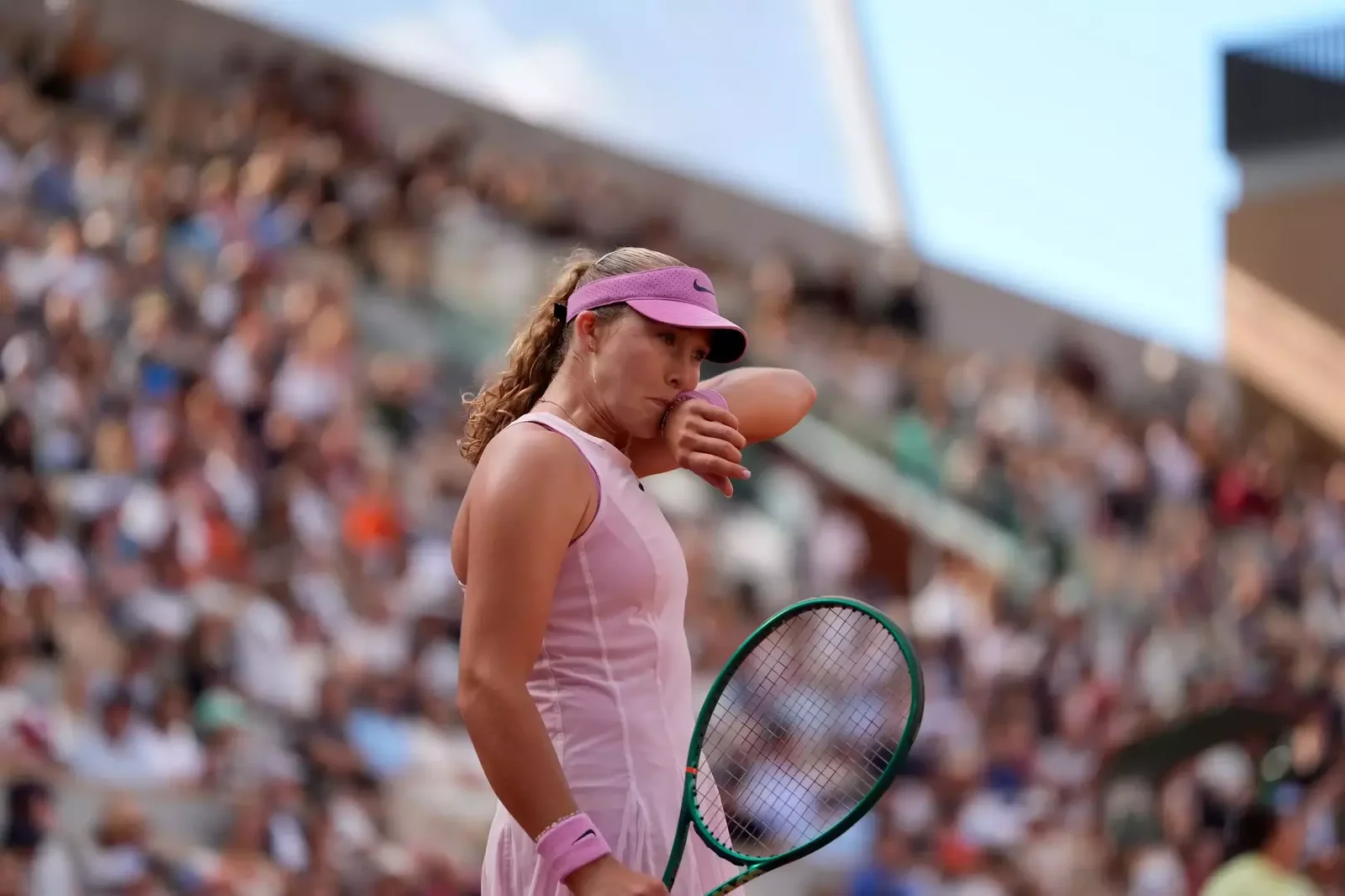
The bottom and top halves have delivered the women's draw to a pair of Thursday semifinals that no forecast saw coming. Mirra Andreeva, the tour's win leader, against Marta Kostyuk, unbeaten on clay all year, is the heavyweight collision the fortnight earned. The other is a fairytale that refuses to end: Diana Shnaider, who dismantled world No. 1 Aryna Sabalenka from a set and a double break down, against qualifier Maja Chwalinska, who has not lost a match in Paris and stands one win from a place no qualifier has ever reached at Roland Garros.
The numbers below come in two layers. The season figures show the form each player carried into Paris; the Roland Garros figures, drawn from these five matches alone, show how they have actually played on this court, in these conditions, over the past ten days - and in places the two tell different stories.
Andreeva and Kostyuk meet in the semifinal the draw deserved
Marta Kostyuk leads the head-to-head 2-0, both meetings on clay and the most recent in Madrid last month, 6-3 7-5, and she arrives at a place no result this year has forced her to leave: unbeaten on the surface in 2026 at 16-0, the only woman in the draw yet to lose a clay match all season, Rouen and Madrid titles behind her. Mirra Andreeva carries the game's heaviest win tally - 20-3 on clay, 34-9 across all surfaces, both tour-leading - a year on from the Paris quarterfinal she lost as the favourite.
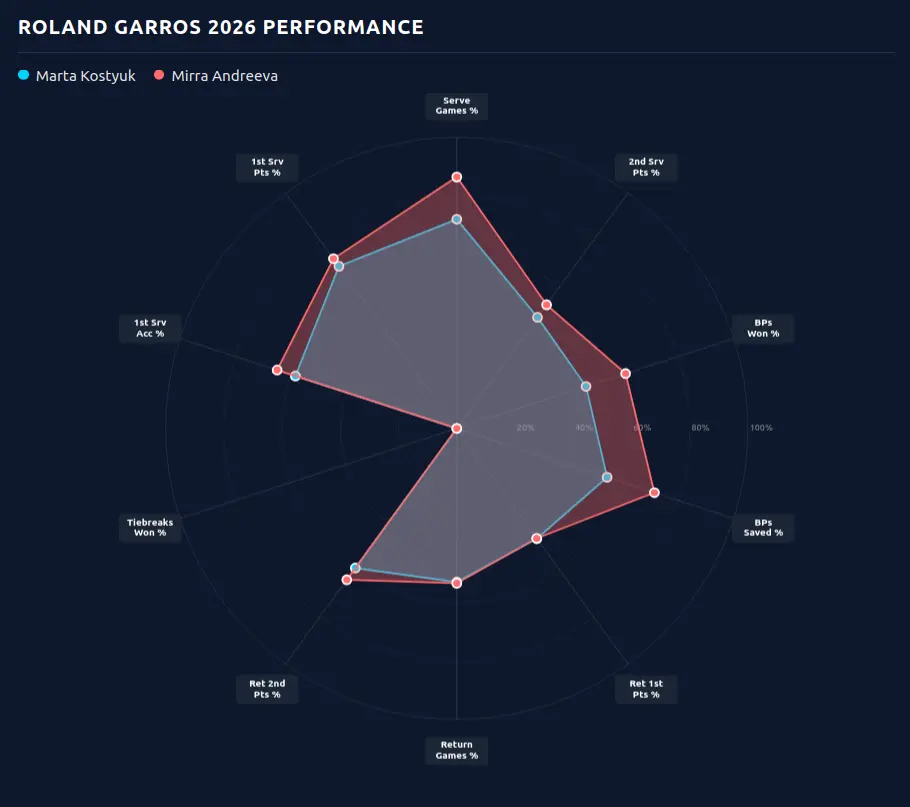
Across the full season the divide between them is clear and sits on return. Kostyuk has been the stronger returner all year, winning 58.0% of her return games to Andreeva's 42.7%, 46.9% of first-serve return points to 40.6%, and 65.6% of second-serve return points to 58.1%, with their serve numbers closer to even. That is the matchup the form guide describes. The trouble for Kostyuk is that it is not the matchup Roland Garros has produced. Across these five matches the return edge has vanished: Andreeva has actually edged the return-games count 53.2% to 52.8% and matched Kostyuk on first-serve return points, while pulling clear on serve in a way her season never suggested - holding 86.4% of her service games here against a 75.4% season rate, and saving 71.4% of break points to Kostyuk's 54.3%. Andreeva has raised her level on arriving in Paris; Kostyuk has played to hers.
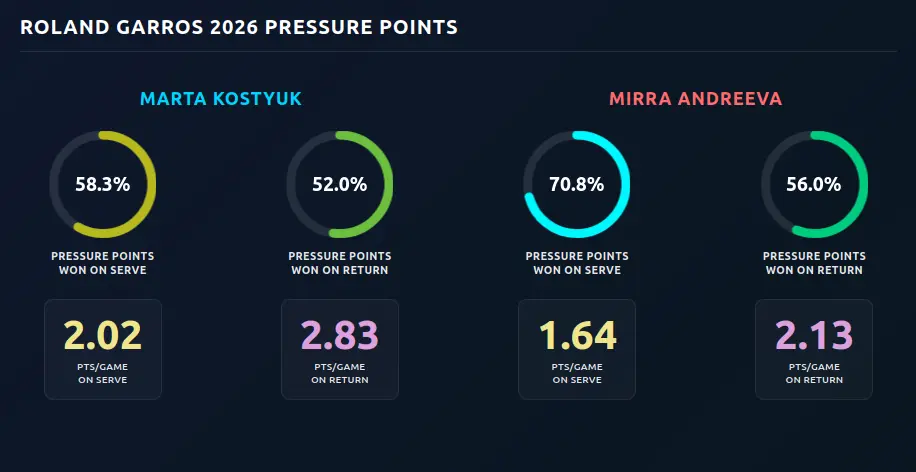
What sets this semifinal apart from the other is the serving. Both women hold at rates the bottom half cannot match - Andreeva at 86.4% in Paris, Kostyuk at 71.9% - and Andreeva in particular leans on it, her whole game built on service games that have been close to untouchable this fortnight. The pressure-points picture sharpens why, and the rate that matters most is not the percentage won but the volume faced and created per game. Andreeva has faced the fewest pressure points on serve of anyone left, 1.64 a game, the signature of a player so rarely troubled on her own delivery that there is little to defend - and she still wins 70.8% of the few that come. Kostyuk sits at 2.02 on serve and 2.83 on return, the profile of a player who drags matches into long, contested patches, defending more in her own service games and generating more pressure on the other side of the net. That return volume, 2.83 a game, is her route in: the way she beats Andreeva is by manufacturing more of those moments than the teenager's serve has allowed anyone to this fortnight. On current form Andreeva has been giving up the fewest, and converting the most when she returns, taking 61.0% of her break points here to Kostyuk's 46.7%.
Shnaider and Chwalinska meet with a first-time finalist guaranteed
One of these two will play for the Roland Garros title, and neither has been past a major quarterfinal before this week. Diana Shnaider authored the upset of the tournament, recovering from a set and a double break to topple Sabalenka 3-6 7-5 6-0, reeling off the last ten games as the world No. 1 came apart in the wind - the first time Sabalenka had dropped a 6-0 set in two years. She is 10-4 on clay this season. Chwalinska's run is the larger story still: the world No. 114, a qualifier, has won every match she has played in Paris to become the second qualifier in the Open Era to reach the women's semifinals here, after Nadia Podoroska in 2020, and the lowest-ranked semifinalist since last year's Lois Boisson. She has taken three top-50 scalps - Mertens, Sakkari and now Kalinskaya - having never beaten a top-50 player before this fortnight.
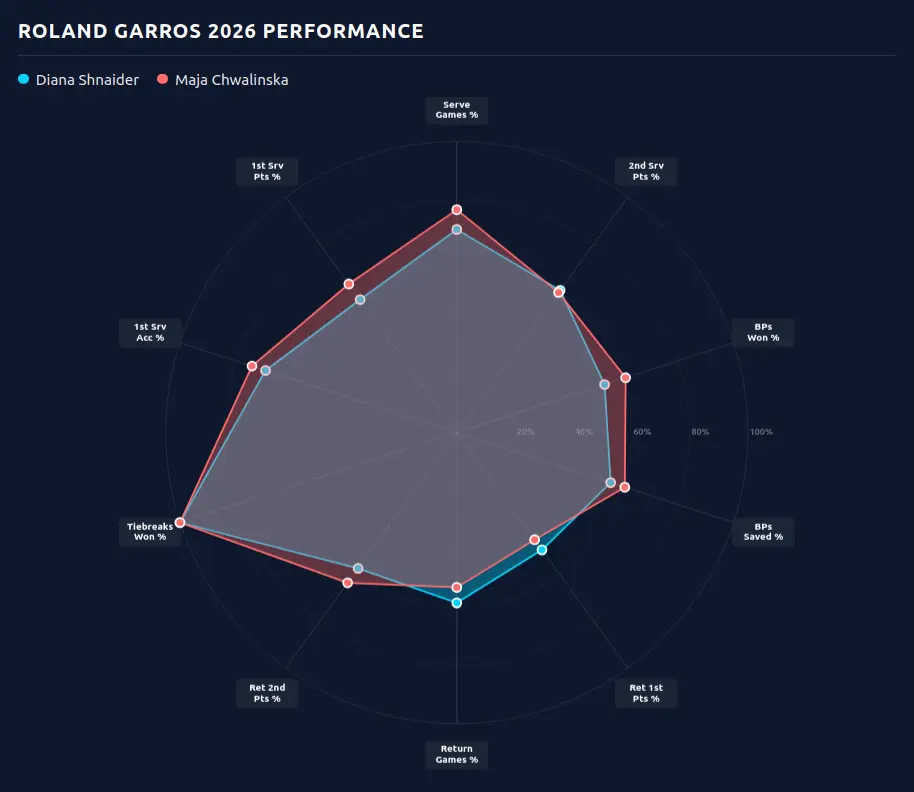
For once, the data on Chwalinska needs no asterisk. Through the season her rate stats are unusable for comparison - Roland Garros is her only WTA main-draw clay event of the year - but restricting both players to these five Paris matches puts them on identical ground, same court, same sample, and the picture is clean. On that like-for-like reading Chwalinska has been the steadier server here, holding 76.6% of her service games to Shnaider's 69.8%, winning 63.1% of first-serve points to 56.5%, and saving break points at 60.7% to 55.6%. She has also converted better, 61.0% of her break points to 53.4%. Shnaider's edges are narrower - the second serve, where she wins 60.4% of points to 59.5%, and first-serve return, 49.8% to 45.5%.
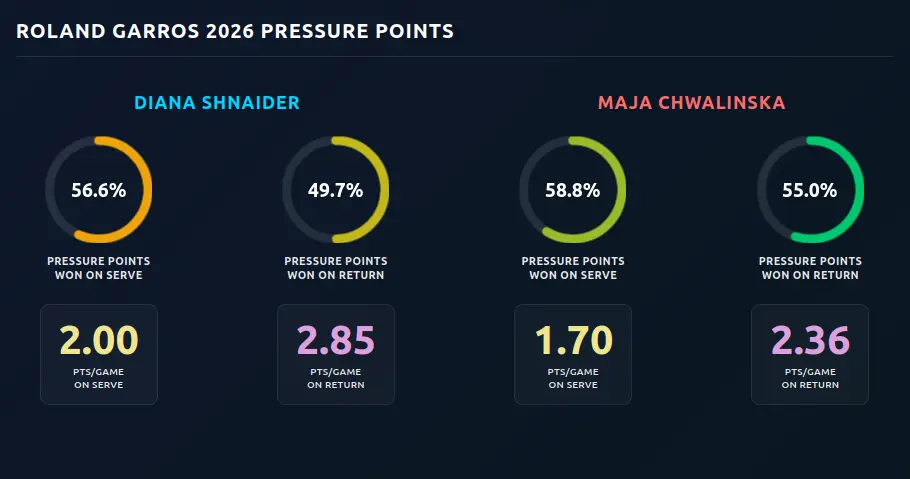
The pressure-points volumes capture the contrast in how they have got here. Shnaider has lived under more strain on serve, facing 2.00 pressure points a game to Chwalinska's 1.70, the calmer service profile belonging to the qualifier whose variety keeps her out of trouble. On return Shnaider generates marginally more, 2.85 a game to 2.36, but Chwalinska wins a far higher share of the ones she plays, 55.0% to 49.7% - the relentless return pressure that has worn down a seeded opponent in round after round. They met once, four years ago at an ITF event in Istanbul, on clay, Shnaider winning - a result with nothing to say about Thursday.
A first-time Grand Slam finalist is guaranteed from the bottom semifinal, where a qualifier ranked No. 114 meets the woman who just dismantled the world No. 1; the top semifinal sends the tour's most prolific winner against its one unbeaten clay player, in a meeting the draw had always seemed to be building toward.


