The final day of the Roland Garros first round delivered exactly what the Paris clay demands: chaos, endurance and defining statements across a packed schedule at the Temple of Clay. Three five-set battles, multiple upsets, and a wave of emerging narratives confirmed once again why this remains the most unforgiving Slam on the calendar. Daniil Medvedev's Paris struggles continued with yet another early exit, his seventh first-round defeat at Roland Garros reinforcing a surface that still refuses to bend to his game. At the other end of the spectrum, Jannik Sinner opened his campaign with the kind of controlled authority that suggested a player already in full tournament mode, beginning what many will see as a clear path forward in Paris. Elsewhere, Felix Auger Aliassime survived the brink of a major collapse, escaping in a super tie-break of the fifth set against Daniel Altmaier in one of the day's most dramatic finishes. The Paris crowd also witnessed the arrival of Moïse Kouame, who became the youngest player in history to win a Grand Slam match, stunning Marin Cilic in straight sets and fully embracing his breakout moment on the biggest stage. In a draw constantly shifting under its own weight, Stefanos Tsitsipas, Adolfo Daniel Vallejo and Roman Andres Burruchaga advanced via retirements from Alexandre Muller, Cameron Norrie and Sebastián Baez respectively, adding further unpredictability to an already fractured opening round. As the dust settles on day one of the main draw, the tone in Paris is already set: endurance tests, generational shifts, and no guarantees beyond the first ball.
Walton shocks Medvedev in chaotic Roland Garros opener
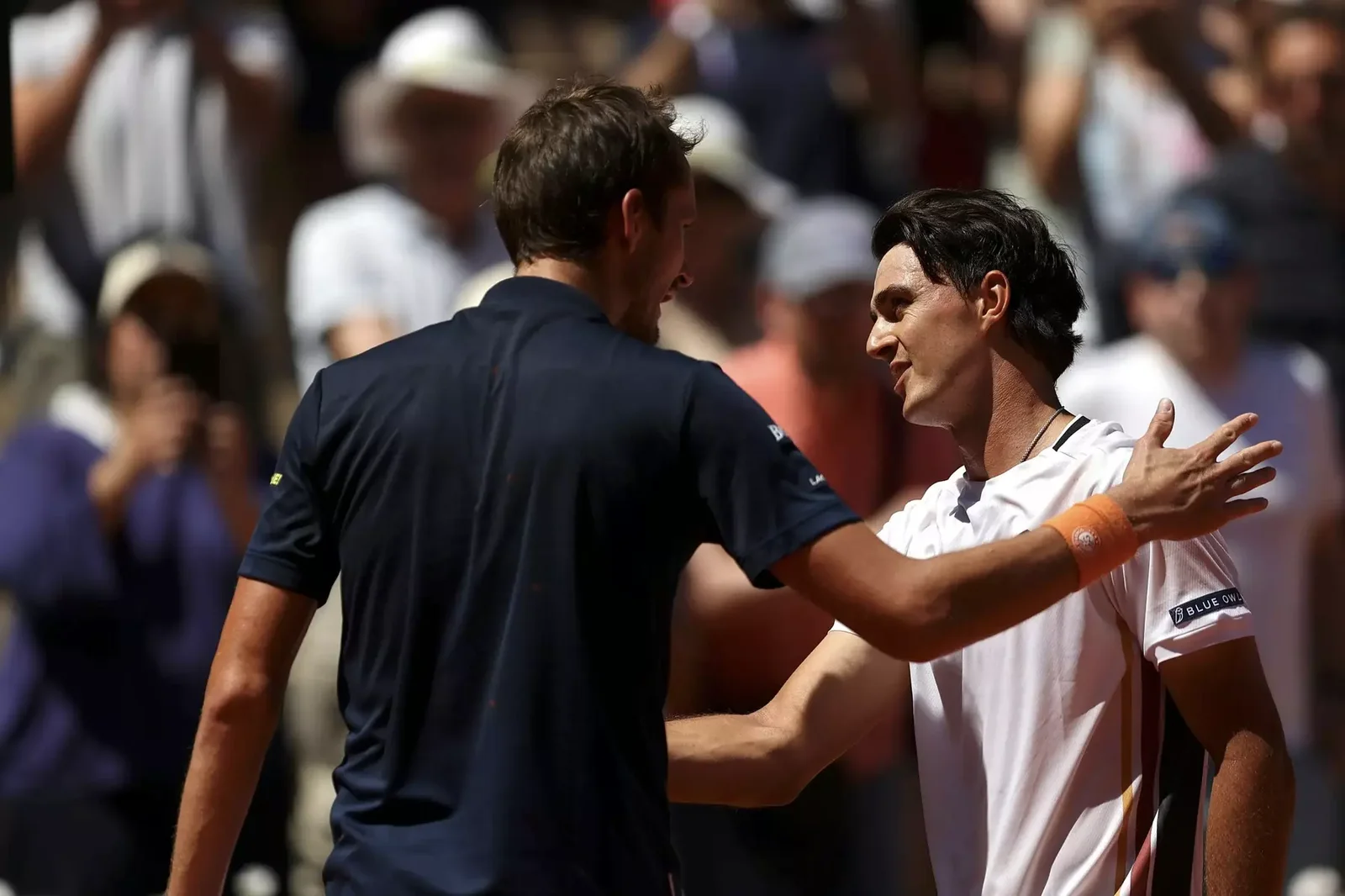
The opening match of the day on the Paris clay delivered an early earthquake, as Adam Walton produced a scrappy but significant upset over Daniil Medvedev, capitalising on yet another frustrating Roland Garros outing for the former world No. 1, who continues to struggle to impose himself on the surface. It was less a match of sustained patterns and more a fragmented exchange of momentum, with both players oscillating wildly between control and collapse. Medvedev, in particular, embodied that inconsistency throughout: moments of clean ball striking and trademark backhand aggression were constantly undermined by untimely errors, rushed net approaches and a generally unclear tactical identity on the slow clay of Paris. Walton, for his part, did not produce anything spectacular in isolation, but that was never required. The Australian's strength was simply staying present in the chaos, surviving the dips better than his opponent and making slightly more sensible decisions in the key passages of the match. In a contest defined by instability, that alone proved decisive. Medvedev's discomfort on clay once again came into focus. Every time he appeared to gain a foothold in rallies, particularly through his backhand wing, the pattern would quickly unravel through unforced errors or poorly constructed points. The lack of patience in extended exchanges remained a recurring issue, with too many games decided in short bursts rather than structured rallies from the baseline. The statistical profile reflects the disorder of the match rather than any clean superiority: both players traded breaks in a contest where neither could establish rhythm for long. Medvedev actually generated more winners overall, but his error count neutralised any advantage, while Walton's steadier return numbers and slightly more efficient conversion in key moments tilted the balance in his favour. In the end, it was not a question of dominance but of survival in disorder. Walton simply handled the volatility better, staying mentally intact through the swings and emerging with one of the most notable wins of his career. He will now face Zachary Svajda in the second round.
Kouamé announces himself with historic straight-sets demolition of Cilic
History was made in emphatic fashion on the Paris clay, as 17-year-old Moïse Kouamé swept aside Marin Čilić 7-6(4), 6-2, 6-1 to become the youngest player ever to win a main-draw match at a Grand Slam, delivering a statement performance far beyond his years.
The opening set briefly hinted at resistance, with Čilić pushing it into a tiebreak, but once Kouamé edged ahead the match tilted sharply in one direction. From there, the French teenager gradually took full control, absorbing the veteran's power and turning the rally pattern into his own rhythm, before completely breaking the contest open in the final two sets. What stood out was not just the result, but the composure. Kouamé never looked rushed, managing key points with a level of tactical maturity that belied his age, particularly on serve where he consistently found solutions under pressure and erased every late threat from Čilić. The numbers underline the gap that opened as the match progressed: Kouamé finished stronger in both baseline exchanges and return pressure, while Čilić's level dropped steadily as the French crowd lifted their teenager through the final stretch. In the end, it became less a contest and more an arrival. A first Grand Slam win, a record rewritten, and a new name firmly introduced to the main stage in Paris. Next up, a second-round clash against Vallejo.
Sinner opens Roland Garros with clinical straight-sets win over Tabur
Jannik Sinner began his Roland Garros campaign in commanding fashion, dispatching Arthur Tabur 3-0 in sets with the kind of controlled authority that has become his trademark at the top of the game. The Italian looked immediately locked in, playing with a "mission mode" intensity that Paris has come to expect from him, especially in a week where he also surpassed Stefan Edberg for total weeks (non-consecutive) at World No. 1, reaching 73. The sense was clear from the first ball: this was not a player easing into a Slam, but one already projecting deep into the second week. Tabur offered brief resistance through his service games, but Sinner consistently raised his level in the return exchanges, particularly on second serve, where he built steady pressure that eventually broke the Frenchman's resistance across the sets. There was also a reminder of unfinished business in Paris. This is the Slam where last year he suffered one of the most painful defeats of his career, squandering three match points against Alcaraz—context that only sharpens his intent this time around. A controlled, efficient opening statement. No alarms, no hesitation. Just the expected rhythm of a player setting the standard from day one.
Auger Aliassime survives Altmaier in three-hour rollercoaster
Felix Auger Aliassime was pushed to the absolute limit before escaping Daniel Altmaier in a dramatic five-set battle decided by a super tie-break, surviving two separate moments on the edge of elimination to close out a marathon that lasted just over three hours. The Canadian, seeded No. 4, came into the match as the clear favourite but was forced into a far more physical and unstable contest than expected by a stubborn and relentless Altmaier, who repeatedly found ways to drag him into extended exchanges and pressure-heavy service games. Statistically, it was a match defined by fine margins on serve: Auger-Aliassime landed more aces and ultimately produced more total winners, but also accumulated a high double-fault count and was constantly under threat on second serve, where Altmaier managed to generate crucial return pressure throughout the contest. The Canadian twice looked in serious trouble, including deep into the deciding stages, but held firm in the biggest moments, particularly in the final stretch where his ability to protect serve under pressure tilted the balance. In the end, it was less a statement win than a survival test: three hours of resistance, tension and momentum swings, with Auger-Aliassime advancing only after absorbing everything Altmaier had to offer.
Arnaldi outlasts Griekspoor in four hours
Matteo Arnaldi continued his strong run of form with a gritty four-hour victory over Tallon Griekspoor, edging a chaotic but high-quality battle 6-7(9), 6-3, 7-6(6), 6-3 to book his place in the second round in Paris. It was a match defined by momentum swings and two brutal tiebreaks, the first cruelly lost despite Arnaldi not conceding a single break point in the set. The Italian, however, refused to unravel: he tightened up on return in the second, then produced his most dramatic surge in the third, saving four match points in the tiebreak before flipping the set with a six-point streak. From there, Arnaldi carried the emotional edge into the fourth, breaking early and managing the lead with increasing authority as Griekspoor's level dipped under pressure. In the end, it was a question of resilience more than dominance: Arnaldi absorbing the chaos better, surviving the key moments, and turning a match of fine margins into another statement win. Next up: Stefanos Tsitsipas.
Vacherot extends his purple patch against qualifier Faurel
Valentin Vacherot continued his standout run of form with a controlled four-set win over French qualifier Faurel, prevailing 3-1 in sets after 2 hours and 45 minutes, in a match where the Monegasque never truly lost control despite moments of resistance. Coming into Roland Garros on the back of his breakthrough stretch last season, Vacherot once again looked comfortable in the bigger picture of rallies and pressure points. Even when Faurel, ranked outside the top 300 and buoyed by qualifying momentum, tried to disrupt rhythm, the Monaco player's serve and baseline stability kept him ahead in the key exchanges. The match followed a familiar pattern: Vacherot dictating behind a strong first serve, while gradually tightening his grip as the sets wore on. Faurel had flashes, but was ultimately unable to sustain enough depth or consistency to force a real shift in momentum. In the end, it was a solid continuation of Vacherot's upward trajectory rather than a statement upset-style performance, efficient, composed, and another step in what is becoming a quietly impressive season.
Struff knocks out Bublik in four-set upgrade clash
Jan Lennard Struff produced one of the more significant wins of the day, defeating Alexander Bublik 7-5, 6-7(6), 6-4, 7-5 in 3 hours and 11 minutes to end the Kazakh's Roland Garros campaign earlier than expected. On a surface Bublik has never fully embraced, the expectation was still that his recent consistency might carry him deeper into the draw, but Struff's heavier baseline hitting and more disciplined patterns proved decisive in the key moments of a tight, physical encounter. The match swung repeatedly, with Bublik's serve keeping him alive through stretches of pressure, but also exposing him to extended return games where Struff gradually built control. The German's ability to stay structurally solid in longer rallies made the difference as the sets tightened. For Bublik, it is a costly early exit given the ranking points at stake, while Struff moves on to face Jaime Faria in the second round after a hard-earned but deserved victory.
Tien continues clay breakthrough with strange but convincing win over Garin
Learner Tien extended his impressive clay-court surge with another statement victory, defeating Cristian Garín in a match defined by extreme swings and momentum collapses, securing his place in the second round at Roland Garros. The American's progress under Cheng continues to stand out, with this latest win adding to his breakthrough run in Geneva and his strong showing in Rome. Once again, Tien looked more comfortable than expected on a surface traditionally far from his natural game, adapting with increasing confidence in longer rallies. The match itself was chaotic: Tien dropped a set but still produced two 6-0 sets, highlighting the volatility that ran through the contest. At times he looked completely in control, especially when dictating from the baseline, while at others Garín briefly found openings to disrupt rhythm and extend exchanges. In the end, it was another sign of rapid evolution rather than polished dominance: Tien still raw in patches, but increasingly dangerous on clay and no longer a pure hard-court specialist.
For a full preview of Wednesday's second-round action, including Fonseca vs Prizmic, Zverev's Olympics rematch with Machac and Djokovic's match, read our day four preview.