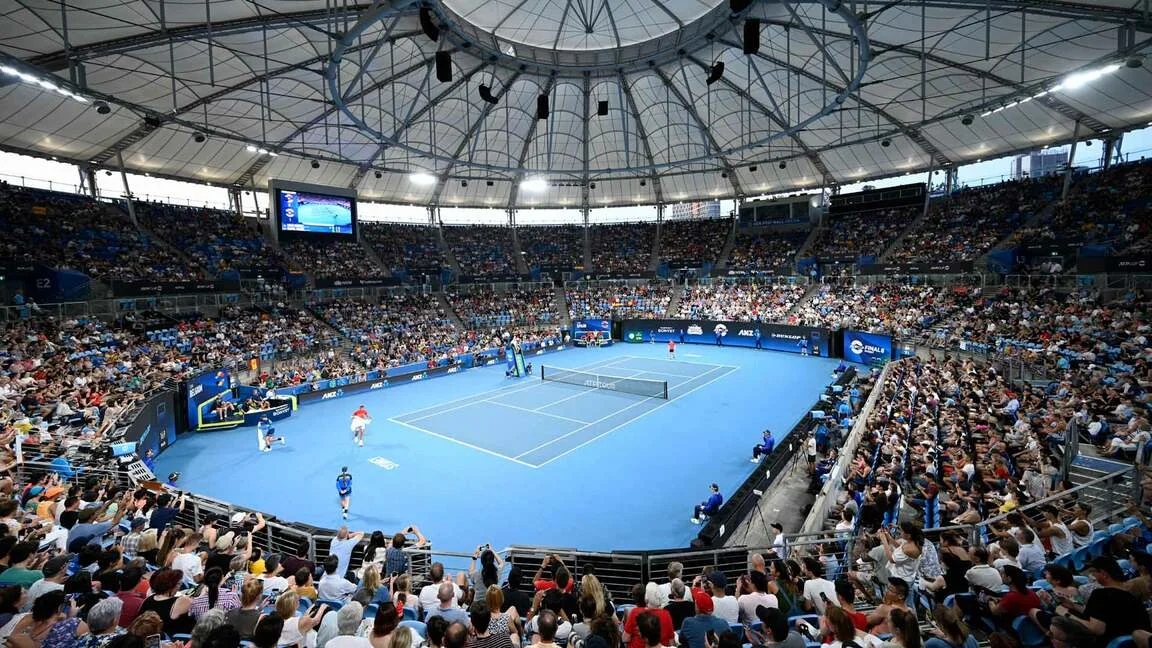
The 2026 tennis season ignites with the United Cup, as 18 nations descend upon Perth and Sydney for ten days of high-stakes mixed-team competition. Starting tomorrow, January 2nd, the fourth edition of this innovative tournament brings together the world's elite from both the ATP and WTA tours, offering not just ranking points and prize money exceeding $11.8 million, but something far more precious: national pride.
Defending Champions Eye Historic Three-Peat
Team USA arrives in Perth as favorites, led by the formidable duo of world No. 3 Coco Gauff and world No. 6 Taylor Fritz. The defending champions, who claimed their second United Cup title in 2025 after defeating Poland in the final, have assembled the same winning roster that proved unstoppable twelve months ago. Gauff enters the tournament having compiled a flawless 5-0 singles record during last year's campaign, while Fritz provides the firepower on the men's side that has made the American team the benchmark for consistency. It's a good chance to start the new season from scratch as both the US team's stars ended the season without much in their tank, getting eliminated in group stages of respectively WTA and ATP finals in November.
Drawn into Group A alongside Spain and Argentina, USA faces a manageable path through the round-robin stage. Spanish hope Jessica Bouzas Maneiro and Argentina's Solana Sierra represent the women's opposition, neither having faced Gauff on tour, while Fritz will square off against Jaume Munar and Sebastian Baez in what should be favorable matchups for the American No. 1.
Germany Seeks Redemption After 2024 Triumph
The 2024 champions arrive with unfinished business. World No. 3 Alexander Zverev leads Germany alongside United Cup debutant Eva Lys in what many consider the tournament's most intriguing group. Placed in Group F in Sydney, Germany faces an immediate showdown with Poland's world No. 2 Iga Swiatek and Hubert Hurkacz, setting up a potential rematch of the dramatic final from two years ago where Germany saved a championship point before prevailing.
This Poland-Germany rivalry has become the tournament's defining narrative. Poland has reached two consecutive finals without lifting the trophy, falling to both Germany in 2024 and USA in 2025. The partnership between six-time Grand Slam champion Swiatek and the reliable Hurkacz has proven formidable, but questions remain whether they can finally break through against elite opposition when it matters most. Hubert Hurkacz is coming back to competition after a few months of absence due to the on-going knee injury, so it's an opportunity for him to gain the vital match practice before full-time comeback to the top level competition.
Italy's Silent Threat
While USA and Germany command headlines, third-seeded Italy may represent the tournament's most complete team. World No. 8 Jasmine Paolini, the 2024 Roland Garros and Wimbledon finalist, who followed those successes with another top 10 year-end finish in 2025, teams with rising star Flavio Cobolli in Group C. Their recent dominance in Davis Cup and Billie Jean King Cup competitions demonstrates Italy's ability to peak in team formats.
Italy faces France and Switzerland, the latter featuring three-time Grand Slam champion Stan Wawrinka in what could be a farewell appearance, alongside world No. 11 Belinda Bencic. The Swiss duo brings experience, but Paolini and Cobolli's momentum from 2025's team competitions makes them favorites to advance.
Canada's Young Guns
Second-seeded Canada boasts arguably the tournament's most in-form pairing. World No. 5 Felix Auger Aliassime finished 2025 strongly and enters alongside teenage sensation Victoria Mboko, whose meteoric rise has captured the tennis world's attention. The Canadian duo headlines Group B in Sydney, facing Belgium's Elise Mertens and Zizou Bergs, plus China's Zhizhen Zhang and Lin Zhu.
Mboko's emergence as Canada's top woman signals a changing of the guard in Canadian tennis. Her partnership with Auger Aliassime, who has matured into one of the ATP's most dangerous competitors on hard courts, gives Canada a legitimate shot at their first United Cup title.
Great Britain's Setback
Late drama struck Great Britain's campaign as world No. 10 Jack Draper withdrew from the tournament - and the entire Australian swing -due to a persistent arm injury that has plagued him since last year's Wimbledon. The withdrawal forces world No. 127 Billy Harris into the spotlight as Britain's top male player, a massive step up in responsibility.
Emma Raducanu, the 2021 US Open champion, now carries Britain's hopes in Group E alongside Greece's Stefanos Tsitsipas and Maria Sakkari who try to regain their legacy after unsuccessful 2025 for both, and United Cup debutants Japan, led by four-time Grand Slam champion Naomi Osaka. Raducanu's return to form saw her climb back into the Top 30 in 2025, but without Draper, Britain's chances of escaping the group appear slim.
Harris, who lost all three singles matches at the 2025 United Cup, faces the daunting prospect of competing against top-tier opposition with a 0-8 career record against top 100 players on hard courts. The pressure falls squarely on Raducanu to deliver in singles, with mixed doubles potentially deciding Britain's fate in critical ties.
Japan's Grand Entrance
The tournament welcomes its most intriguing newcomer: Japan, making its United Cup debut with Naomi Osaka leading the charge. The former world No. 1 and two-time Australian Open champion (2019, 2021) returned to the Top 15 in 2025 after her maternity break, showing flashes of the brilliance that made her a Grand Slam powerhouse.
Osaka's opening match against Maria Sakkari on Friday night in Perth represents one of the tournament's marquee fixtures. The fiery Greek competitor, known for her intensity and fighting spirit, provides a stern test for Japan's ambitions. Paired with 2019 Junior Wimbledon champion Shintaro Mochizuki, Japan may lack star power on the men's side, but Osaka's ability to elevate her game on Australian hard courts makes them dangerous.
ATP Field Analysis: The Big Servers and Baseline Warriors
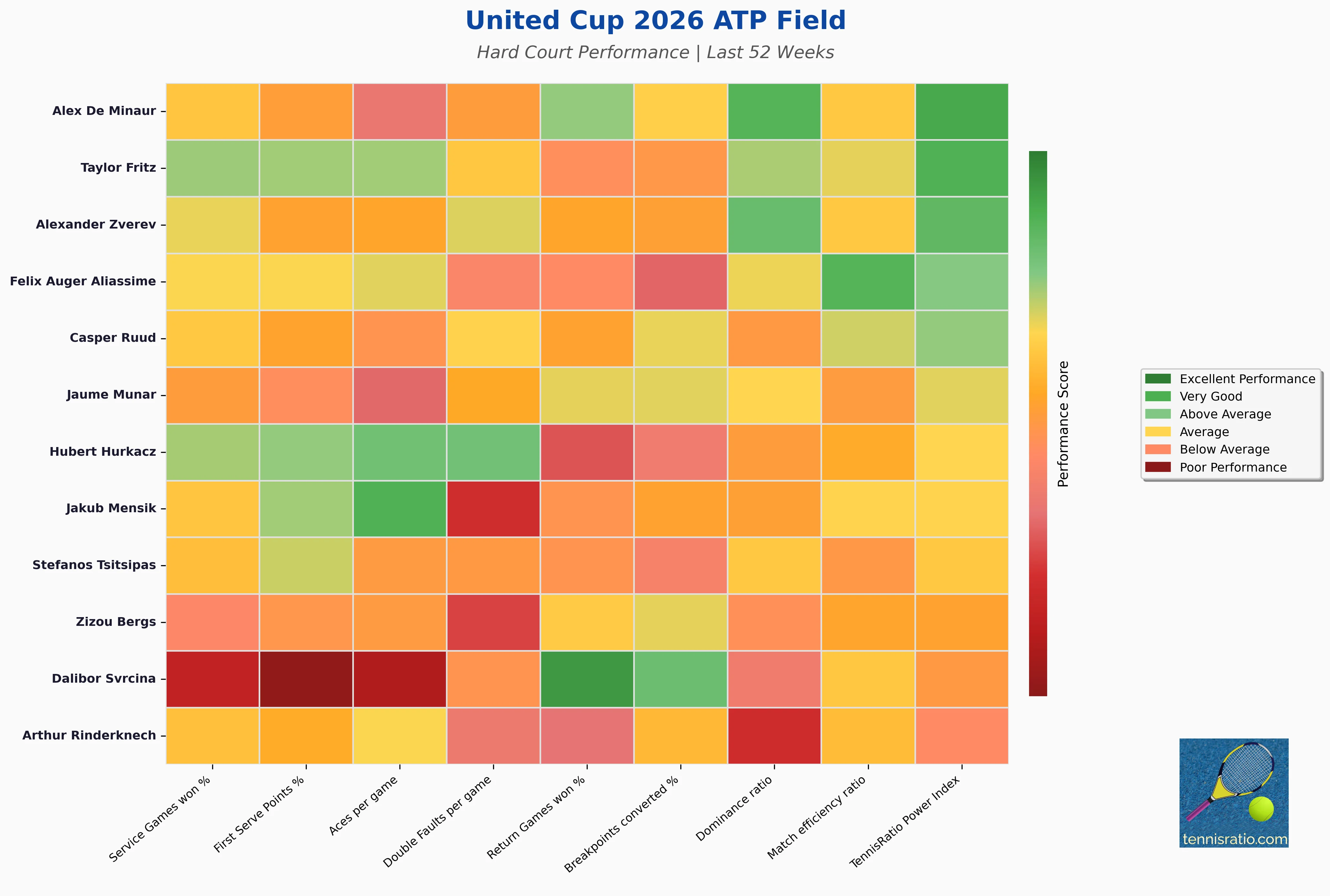
The ATP heatmap exposes clear patterns in playing styles and current form. Taylor Fritz and Alex de Minaur stand out with exceptional service games, both showing deep green across service games won and first serve points - critical metrics on fast Australian hard courts. Fritz's consistency across breakpoints converted and return games won suggests he's firing on all cylinders entering Perth, while de Minaur's tournament-high power index indicates the Australian is hitting harder than ever, a concerning development for opponents facing him with home crowds roaring.
Alexander Zverev displays the profile of a complete hard-court player: strong service numbers, excellent ace-per-game ratio, and solid baseline consistency. His match efficiency ratio sits in the green, suggesting he's winning matches without unnecessary energy expenditure - crucial for the grueling tournament format. Felix Auger-Aliassime shows similar completeness, particularly excelling in service games won and aces per game, though his double faults per game creep into orange territory, a potential vulnerability under pressure.
WTA Field Analysis: Power vs. Consistency
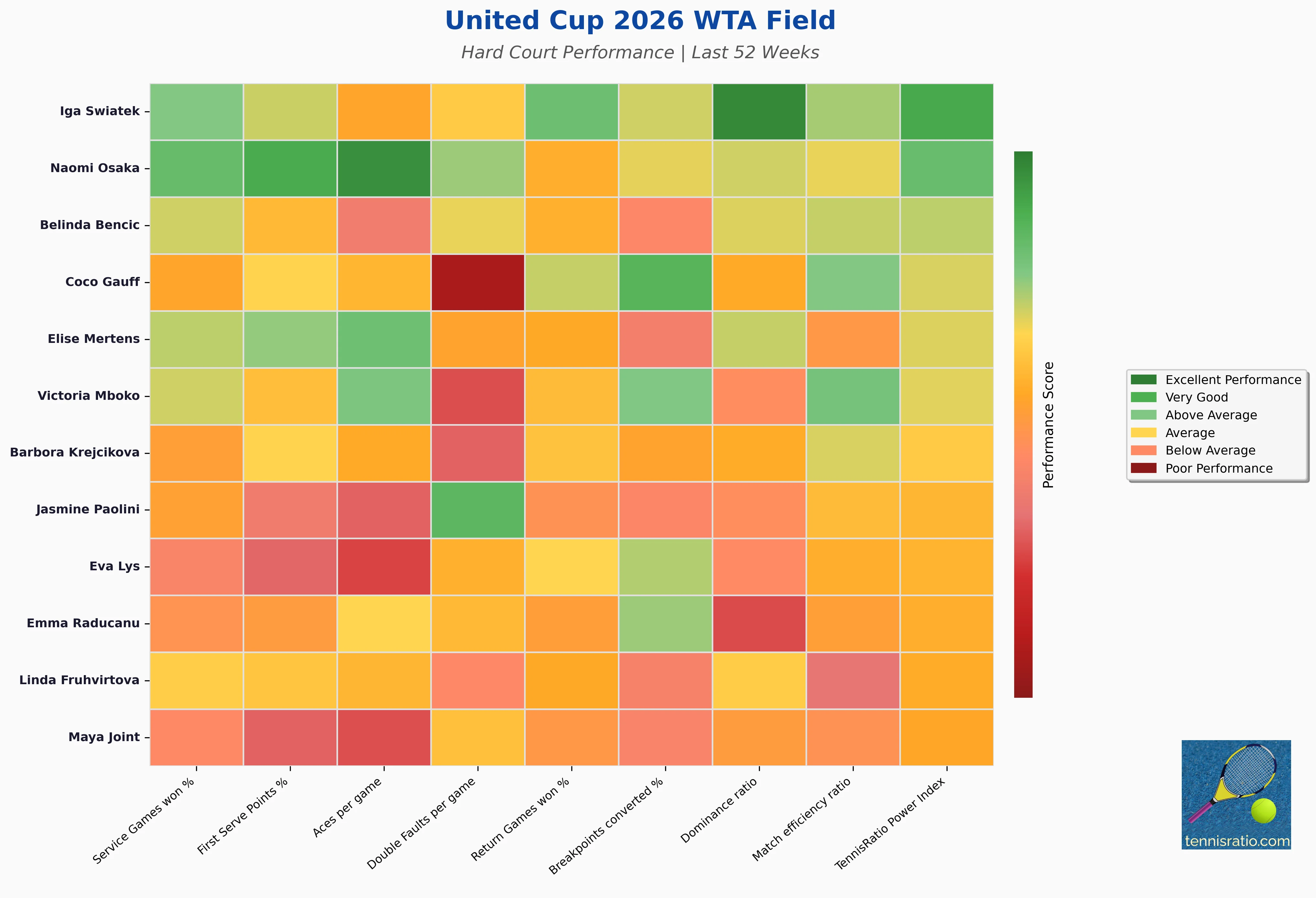
The women's heatmap reveals a different competitive landscape. Iga Swiatek's profile screams consistency and power: excellent service games won, strong first serve points, and crucially, elite-level dominance ratio and match efficiency. The Polish star arrives in championship form, her green-heavy heatmap suggesting she's ready to carry Poland deep into the tournament.
Naomi Osaka's data offers encouragement for Japan's debut. Strong service games won, excellent first serve points percentage, and solid baseline metrics indicate her game has rounded into form after her comeback. Her power index sits respectably in the green, suggesting the aggressive style that won her four Grand Slams remains intact on hard courts.
Belinda Bencic shows mixed signals: average across most categories with concerning reds in aces per game and some baseline metrics. For Switzerland's chances, this suggests Wawrinka must carry significant weight, as Bencic's form appears inconsistent heading into Australia. Coco Gauff's heatmap reveals her greatest weakness: double faults per game sits in deep red, a troubling sign for pressure moments. However, her return games won, breakpoints converted, and dominance ratio all shine green, confirming her status as one of hard court's most dangerous players despite the serving struggles.
Elise Mertens demonstrates the profile of a crafty veteran: solid across most categories without exceptional strengths, relying on consistency rather than domination. Victoria Mboko's data shows promise with above-average marks across most metrics, though her dominance ratio and match efficiency remain in yellow—understandable for a teenager still developing closing skills.
Format and Path to Glory
The tournament's structure splits the 18 nations into six groups of three, with Groups A, C, and E competing in Perth from January 2-6, while Groups B, D, and F battle in Sydney from January 3-7. Each tie consists of one men's singles match, one women's singles match, and a decisive mixed doubles rubber if needed—all featuring each nation's top-ranked singles players.
Group winners automatically advance to the quarterfinals, with the best runner-up from each city claiming the remaining two spots. Perth hosts its quarterfinal on January 7, while Sydney stages its knockout matches on January 8-9. Teams advancing from Perth receive a travel and rest day before the semifinals, which take place on January 10 in Sydney, culminating with the final on Sunday, January 11.
Let's follow-up all the action from United Cup featuring match schedules, new complex H2H match previews for both ATP and WTA fixtures and daily recaps on TennisRatio.